Introduction
Pier Paolo Pasolini (1922–1975) worked across poetry, novels, cinema, criticism and political polemic. His late interventions are often quoted for their prophetic tone, but their lasting interest lies less in prophecy than in a theory of formation.
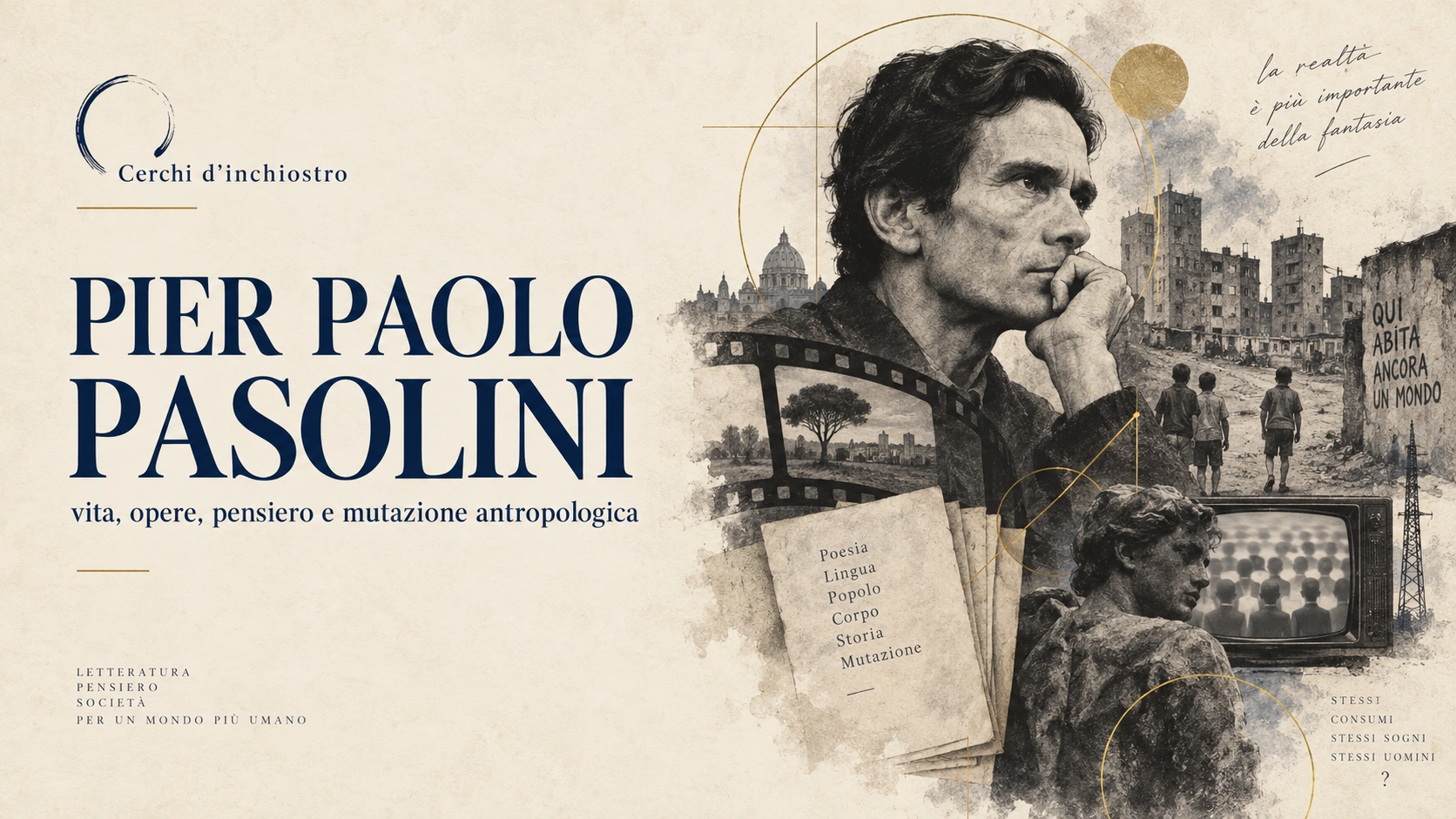
Pasolini argued that postwar modernization and consumer society were not merely changing habits. They were changing bodies, speech, aspirations and models of happiness: an anthropological mutation.
For Circles of Ink, the question is precise: what happens when the strongest educational institution is no longer school, family or party, but the environment of goods, images and desirable lifestyles?
Pasolini in five minutes
Poet, novelist, filmmaker and public intellectual, Pasolini moved between Friulian poetry, Roman subproletarian life, cinema and the newspaper polemics later collected in Scritti corsari and Lettere luterane.
His work cannot be reduced to a single political doctrine. It is marked by unresolved tensions: tradition and revolt, sacredness and materialism, popular cultures and modernization, emancipation and loss.
Anthropological mutation
By “anthropological mutation,” Pasolini meant a transformation deeper than fashion. The expansion of consumer society was producing new gestures, desires, speech patterns and social models.
The claim is deliberately strong and remains contestable. Its analytical value lies in directing attention toward the production of people, not only the production of goods.
Cultural homogenization
Pasolini used the Italian term omologazione to describe pressures toward cultural sameness. In English, “homogenization” often captures the mechanism better than the literal “homologation.”
The point was not that differences instantly disappeared. It was that a national consumer culture could make formerly distinct ways of speaking, desiring and presenting oneself converge around common models.
The pedagogy of things
One of Pasolini’s most fertile intuitions is that education is carried by things: houses, streets, clothing, television, commodities, gestures and built environments. They communicate what is normal and desirable without issuing explicit lessons.
This enlarges the concept of pedagogy. A society educates through what it repeatedly places before people and rewards them for wanting.
Television, language and centralized desire
Pasolini saw television as more than a medium. It helped standardize language and models of life at national scale, entering domestic space with an authority older institutions could not match.
His diagnosis was historically situated in Italian television of the 1960s and 1970s. The broader question survives: what changes when the most continuous cultural instruction is delivered by systems optimized for attention and consumption?
What must be kept — and what must be questioned
Pasolini’s critique can romanticize lost popular worlds and sometimes turns social change into an image of irreversible catastrophe. Those limits matter. Rural poverty, patriarchal structures and marginalization cannot be treated as innocent alternatives to modernization.
The strongest use of Pasolini is therefore diagnostic, not nostalgic: he gives language to the cultural power of environments while requiring us to separate real losses from idealized pasts.
The contemporary wound
Today the environment is more personalized and less centralized than the television system Pasolini attacked. Platforms, recommender systems, creators, brands and peer networks distribute pedagogy continuously.
The Pasolinian question becomes: who forms desire when no institution can plausibly claim to be the main educator?
Primary texts and orientation
Primary orientation: Pier Paolo Pasolini, essays collected in Scritti corsari (1975) and Lettere luterane (1976), together with his poetry, fiction and cinema as the broader field in which language, bodies and modernization are explored.
This English edition translates omologazione contextually as “cultural homogenization” and preserves “anthropological mutation” as Pasolini’s deliberately forceful formulation.
Continue reading
The triad: who — and what — forms a people?
Read this guide as one node in the Manzoni–Collodi–Pasolini triad, where shared language, lived formation and environmental pedagogy meet.