Introduction
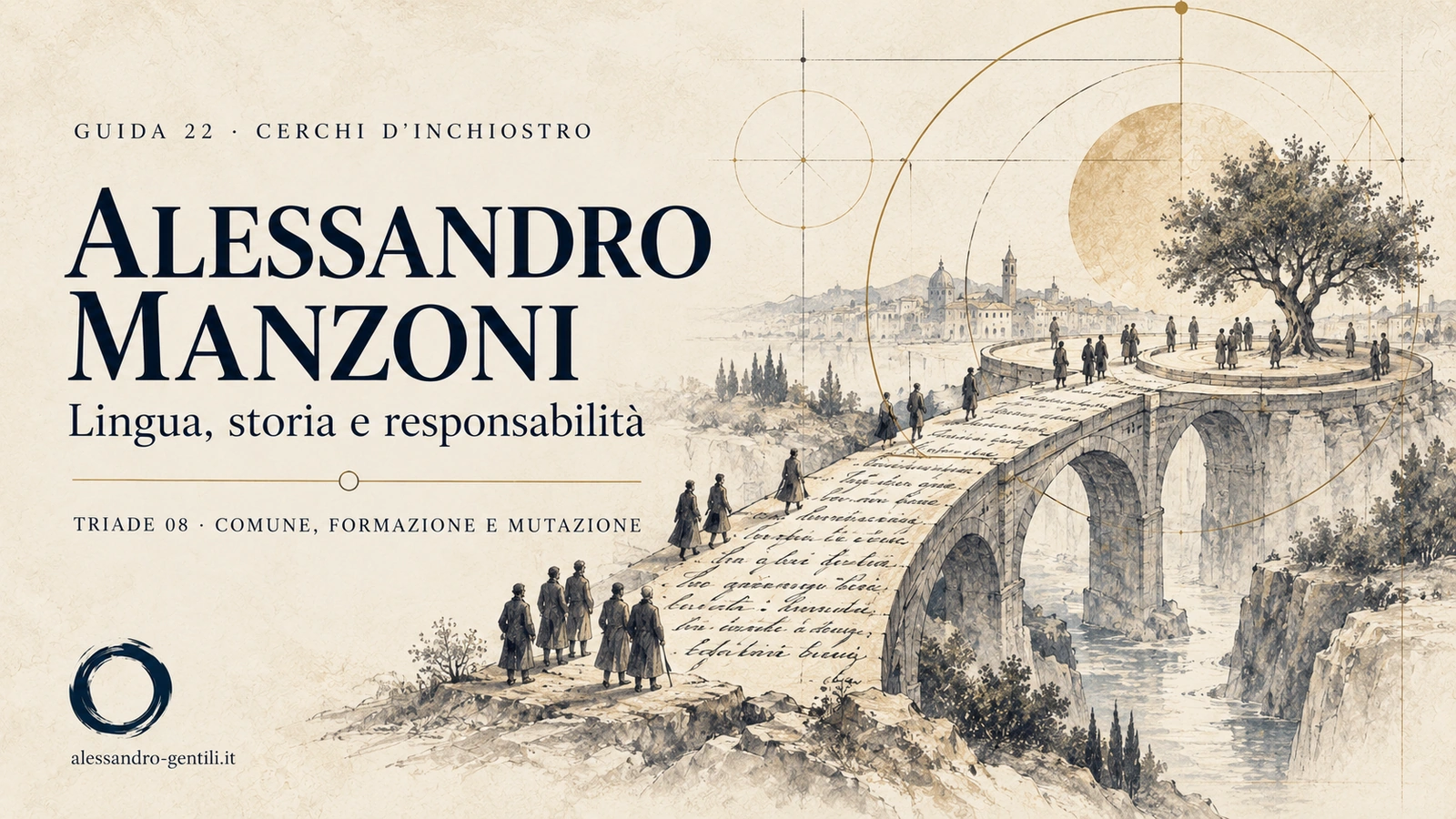
Alessandro Manzoni (1785–1873) is so embedded in Italian cultural memory that familiarity can make him look simpler than he is. He is the author taught at school, the novelist associated with national language, the Catholic writer of Providence and the civic figure linked to nineteenth-century Italy.
Yet his work repeatedly stages situations in which the common world fails: law cannot protect the weak, fear creates scapegoats, crowds convert suffering into certainty, institutions ratify error and language itself is not sufficiently shared.
For Circles of Ink, the central problem is therefore not “national identity” in the abstract. It is more demanding: what conditions allow people to understand one another, judge together and remain responsible when history places them under pressure?
Manzoni in five minutes
Poet, dramatist, novelist, historian and theorist of language, Manzoni lived across the Napoleonic age, Restoration, Risorgimento and the formation of unified Italy. His major works include the Sacred Hymns, Il conte di Carmagnola, Adelchi, “The Fifth of May,” The Betrothed (I promessi sposi), History of the Infamous Column and later writings on history and language.
The Betrothed is decisive because it places ordinary people inside systems larger than themselves: war, famine, plague, class power, law, religion and economic vulnerability.
Judgment under pressure
Manzoni’s most modern question may be epistemic before it is moral: what happens to judgment when fear rises faster than knowledge? During plague, rumor and institutional authority can reinforce each other until suspicion looks like evidence.
History of the Infamous Column intensifies the issue by asking how judges could become responsible for injustice even within the constraints of their own time. The point is not that institutions operate outside history; it is that historical limits do not dissolve individual responsibility.
The shared world is built, not given
A community requires infrastructures of the common: language, memory, institutions and practices capable of distinguishing evidence from desire. Manzoni does not offer a harmonious people already in possession of these goods. He shows how fragile they are.
“The people” therefore cannot be reduced to a moral category. Crowds may express genuine deprivation and still become vulnerable to simplification, rumor and violence. The common world must be continuously constructed.
Language as civic infrastructure
Manzoni’s language question is inseparable from the political problem of a country divided by local speech, uneven literacy and social distance. His long revision of The Betrothed moved toward contemporary educated Florentine usage as a possible common model.
He did not “invent Italian.” The language had a centuries-long literary history, and national linguistic unification depended on schooling, mobility, administration, media and economic change. His contribution matters because he understood that a political community also needs conditions of mutual intelligibility.
Weak law, unjust law and institutional responsibility
In The Betrothed, law can exist on paper and fail in practice when power is asymmetrical. Elsewhere, institutions can become active producers of injustice. These are different failures: one is incapacity, the other is wrongful action under the authority of procedure.
Manzoni’s work is strongest when it refuses the comfortable idea that responsibility disappears inside a system. Systems constrain; people still decide within them.
History and the responsibility of narrative
Manzoni eventually became increasingly uneasy about mixing documented events and fictional invention in historical narrative. The problem was not hostility to imagination but the status of truth: readers may assign the same authority to what is documented and what has been invented.
This concern links literary form to civic responsibility. How a society narrates the past affects what it believes it knows.
The contemporary wound
The contemporary wound appears when a community is required to judge before it has built the conditions of common judgment: shared language without shared meanings, abundant information without trusted procedures, institutions under reputational pressure, and narratives that move faster than verification.
Manzoni remains useful because he forces us to ask not only what a community believes, but what makes responsible collective belief possible.
Primary texts and orientation
Primary orientation: Alessandro Manzoni, I promessi sposi (definitive 1840–42 edition); Storia della colonna infame (1842); “Sul Romanticismo” (1823); Del romanzo storico (1850); writings on the Italian language including the 1868 report on linguistic unity.
This English edition preserves the conceptual architecture of the Italian guide while adapting terminology and emphasis for international readers.
Continue reading
The triad: who — and what — forms a people?
Read this guide as one node in the Manzoni–Collodi–Pasolini triad, where shared language, lived formation and environmental pedagogy meet.