Introduction
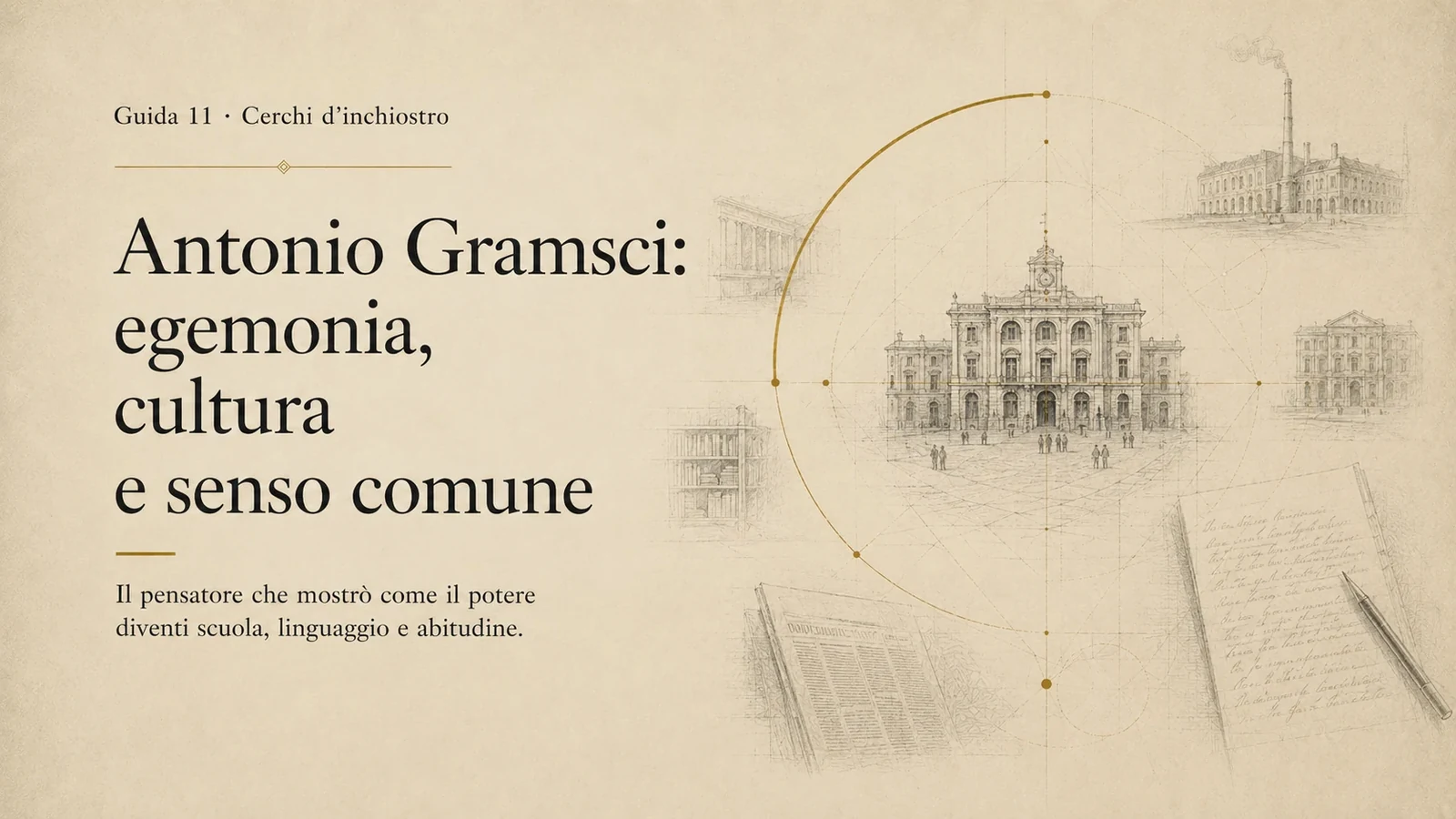
Antonio Gramsci (1891–1937) asks us to look beyond the visible forms of command. Law, police, government and coercion matter, but durable political order also depends on culture, institutions, education, language and habits that shape what a society considers normal.
The Italian guide treats hegemony not as a synonym for propaganda and not as a conspiracy theory. It is the capacity of a historical force to build consent, moral direction and a shared horizon in which its order can appear general rather than merely particular.
Gramsci therefore belongs in this triad because obedience is learned as well as enforced.
Hegemony beyond domination
Hegemony names a form of direction that works through consent, culture, education, institutions and a vision of the world as well as through coercion. It is slower and deeper than propaganda.
Propaganda tries to persuade about a proposition. Hegemony helps shape the frame within which some propositions already look realistic, respectable or inevitable before debate begins.
Common sense and good sense
For Gramsci, common sense is not simply ignorance. It is a historically layered mixture of inherited phrases, practical experience, religion, prejudice, fragments of philosophy, memory and contradiction.
“Good sense” names a more critical and coherent element that can emerge within this unstable field. Politics therefore includes the struggle over how ordinary experience is interpreted and organized, not only the struggle over formal institutions.
Organic intellectuals: organizing a worldview
Gramsci broadens the idea of the intellectual. Intellectuals are not only professors or writers; they can be figures and institutions that give language, continuity and organization to a social group’s experience and interests.
The source guide makes an important contemporary caution: algorithms are not “organic intellectuals.” They have no historical consciousness or moral responsibility. The useful question is which people, institutions and organizations use technical infrastructures to make a worldview durable and credible.
The integral state: coercion and consent
Gramsci does not reduce the state to government offices or repression. His broader analysis connects political society and civil society, coercion and consent, institutions and everyday cultural formation.
Schools, churches, newspapers, associations and other social institutions participate in the production of consent. This does not mean that every institution is simply an instrument of a single center; it means that political order is sustained through a wider social fabric than command alone.
The Prison Notebooks as a laboratory, not a slogan mine
The Prison Notebooks were written under incarceration and published posthumously. The Italian guide stresses their layered and philologically delicate character. They are not a single finished “book of hegemony.”
Notes on Machiavelli, Americanism and Fordism, subaltern groups, language, literature, school and the modern state belong to a research laboratory whose ordering and editorial history matter. Reliable critical editions are therefore essential.
Freedom begins by historicizing what seems natural
Gramsci’s human problem is the fact that people think with words, institutions and inherited categories they did not choose. Freedom cannot mean a fantasy of standing outside history.
It begins when a person or group can identify which parts of experience are historical rather than natural, constructed rather than inevitable, and then build a more coherent language for understanding and acting within that history.
The contemporary wound: the struggle over what seems obvious
The source guide’s contemporary wound is the struggle to define normality: what counts as realistic, competent, safe, progressive, dangerous, visible or worthy of attention.
Digital platforms, media, schools, political language, corporate vocabularies and recommendation systems can all participate in environments where some words and fears become easier to repeat than others. The guide is careful not to turn Gramsci into a prophet of social media.
No social order is innocent of its common sense: every normality has a history, and freedom begins when that history becomes visible.
Primary texts and orientation
Primary orientation: Antonio Gramsci, Prison Notebooks, Letters from Prison, journalistic and political writings, writings on the Southern Question, and Notebook clusters on Machiavelli, the modern state, Americanism and Fordism, and subaltern groups.
The Italian guide stresses editorial caution. It identifies Valentino Gerratana’s 1975 critical edition for Einaudi as a central reference and distinguishes Gramsci’s text from later thematic groupings, editorial ordering and critical interpretation. The English localization therefore prefers controlled paraphrase over decorative quotation.
Continue reading
The triad: unconscious, hegemony, sovereignty.
Read this guide as one node in the Freud–Gramsci–Hobbes triad: three different ways of asking why people obey — through inner conflict, cultural formation and the search for political protection.