Introduction
Niccolò Machiavelli (1469–1527) was a Florentine official, political thinker, historian and writer. He learned politics inside the machinery of the Florentine Republic and thought it most radically after being expelled from that machinery.
The fall matters. Diplomatic missions, military questions and negotiations had taught him politics as practice; exclusion turned experience into theory.
For Circles of Ink, Machiavelli’s problem is not the slogan that “the ends justify the means.” It is the distance between what power says about itself and the conditions through which it actually acts.
Machiavelli in five minutes
Among Machiavelli’s major works are The Prince, the Discourses on Livy, The Art of War, Florentine Histories, Mandragola, the Life of Castruccio Castracani and his letters, especially the letter to Francesco Vettori of 10 December 1513.
His political vocabulary includes virtù, fortuna, necessity, occasion, conflict, arms, corruption and — above all — verità effettuale, effectual truth.
The fall: thinking power from exclusion
Machiavelli understood power first as a civil servant: correspondence, missions, armies, alliances, waiting and decision. After 1512, exclusion from public life turns that practical knowledge into a wound.
This is essential to The Prince. The observer of power is no longer protected by office. He has to ask what political action looks like when ideals, intentions and formal institutions are exposed to instability.
Effectual truth: looking at politics as it works
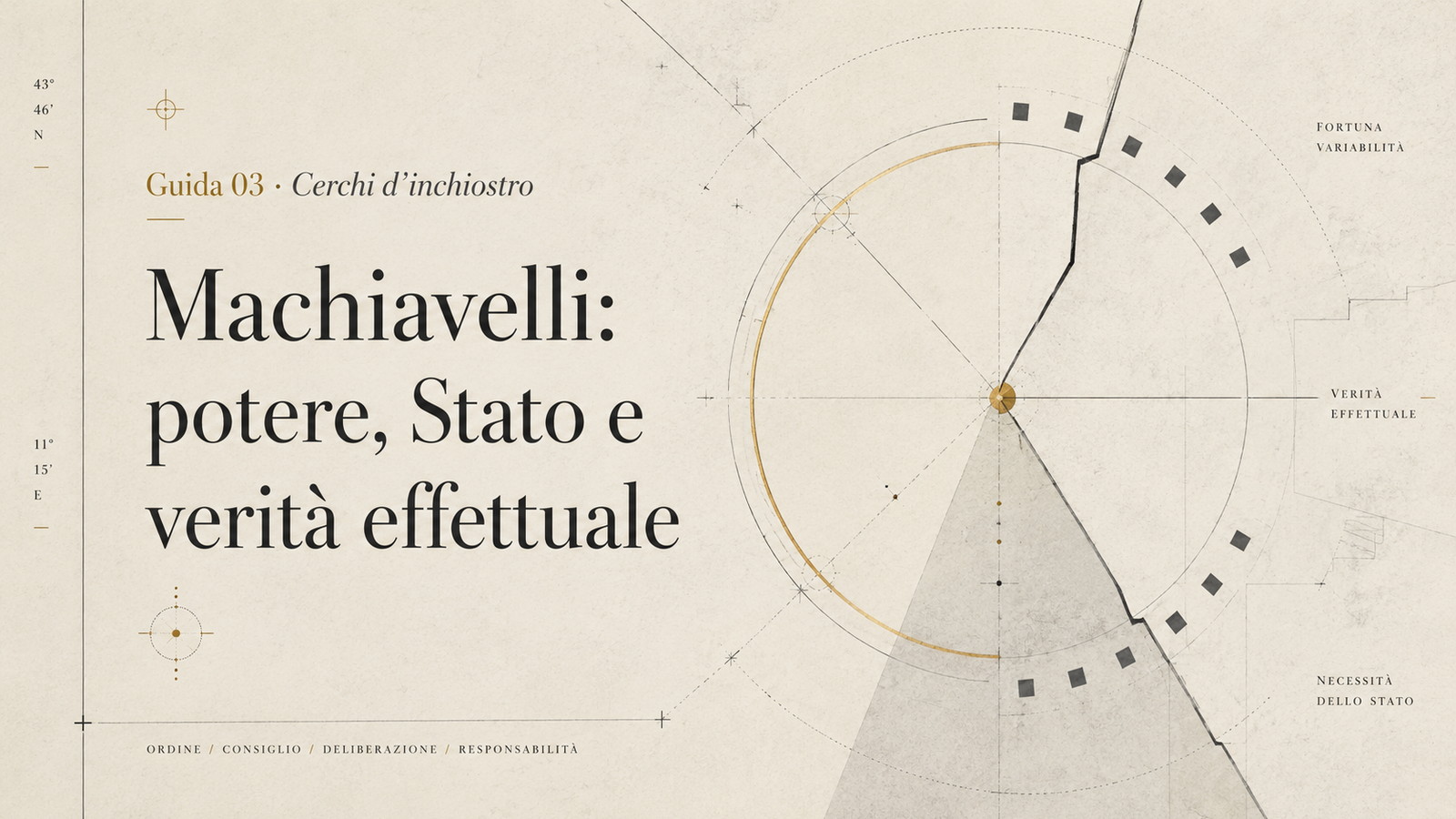
Verità effettuale does not mean that the world is bad and therefore one should be bad. The Italian guide rejects that caricature. It is a method of looking: begin from politics as it functions, not as it wishes to appear.
That means examining forces, fears, interests, factions, consequences, dependencies and capacities. The opposite of Machiavellian realism is not morality; it is self-deception.
The Prince and the Discourses: decision and duration
The Prince and the Discourses are best read as two entrances into the same problem. The Prince studies moments of foundation, crisis and concentrated decision — the compressed time in which someone must act before events decide in their place.
The Discourses study duration: how a republic can contain corruption, give form to conflict and transform social tensions into laws and liberty.
The central relation is precise: decision without institutions burns out; institutions without political capacity lose contact with reality.
Virtù, fortuna and political capacity
Fortuna names the field of what cannot be fully controlled: crises, reversals, external events and changing circumstances. Virtù is not ordinary moral virtue but political capacity — judgment, courage, adaptability, self-command and the ability to give form to unstable conditions.
Machiavelli is therefore neither fatalist nor worshipper of will. Politics exists in the space between what can be prepared and what remains unpredictable.
Conflict, institutions and republican freedom
Machiavelli does not treat conflict as a defect that good institutions simply eliminate. In the Roman example, conflict can produce liberty when institutions give it a form.
This makes political order dynamic. Stability is not silence; it is the capacity to channel competing forces without allowing either private interest or concentrated command to consume the republic.
The contemporary wound: the hypocritical removal of power
The Italian guide’s contemporary wound is direct: modern societies have not abolished power; they have made it harder to name. Values, rights, sustainability, participation, innovation and community are meaningful words, but they can become screens if they obscure who decides, who pays, who controls infrastructure and where real capacity lies.
The result can be a society that is morally noisy and politically blind — rich in declarations, weak in the ability to see the actual distribution of power.
Machiavelli remains necessary because he does not ask us to abandon values. He asks whether our values understand the conditions required to defend them.
Primary texts and orientation
Primary orientation: Niccolò Machiavelli, The Prince, Discourses on Livy, The Art of War, Florentine Histories, Mandragola, Life of Castruccio Castracani and the letters, especially the letter to Francesco Vettori of 10 December 1513.
The Italian guide prioritizes scholarship by Gennaro Sasso, Federico Chabod, Quentin Skinner, Maurizio Viroli, Felix Gilbert and J. G. A. Pocock, alongside reference resources including Treccani and the Stanford Encyclopedia of Philosophy.
Continue reading
The triad: truth, language, power.
Read this guide as one node in the Plato–Dante–Machiavelli triad: three different ways of asking how a city can distinguish truth, give shared form to experience and confront power as it actually works.