Introduction
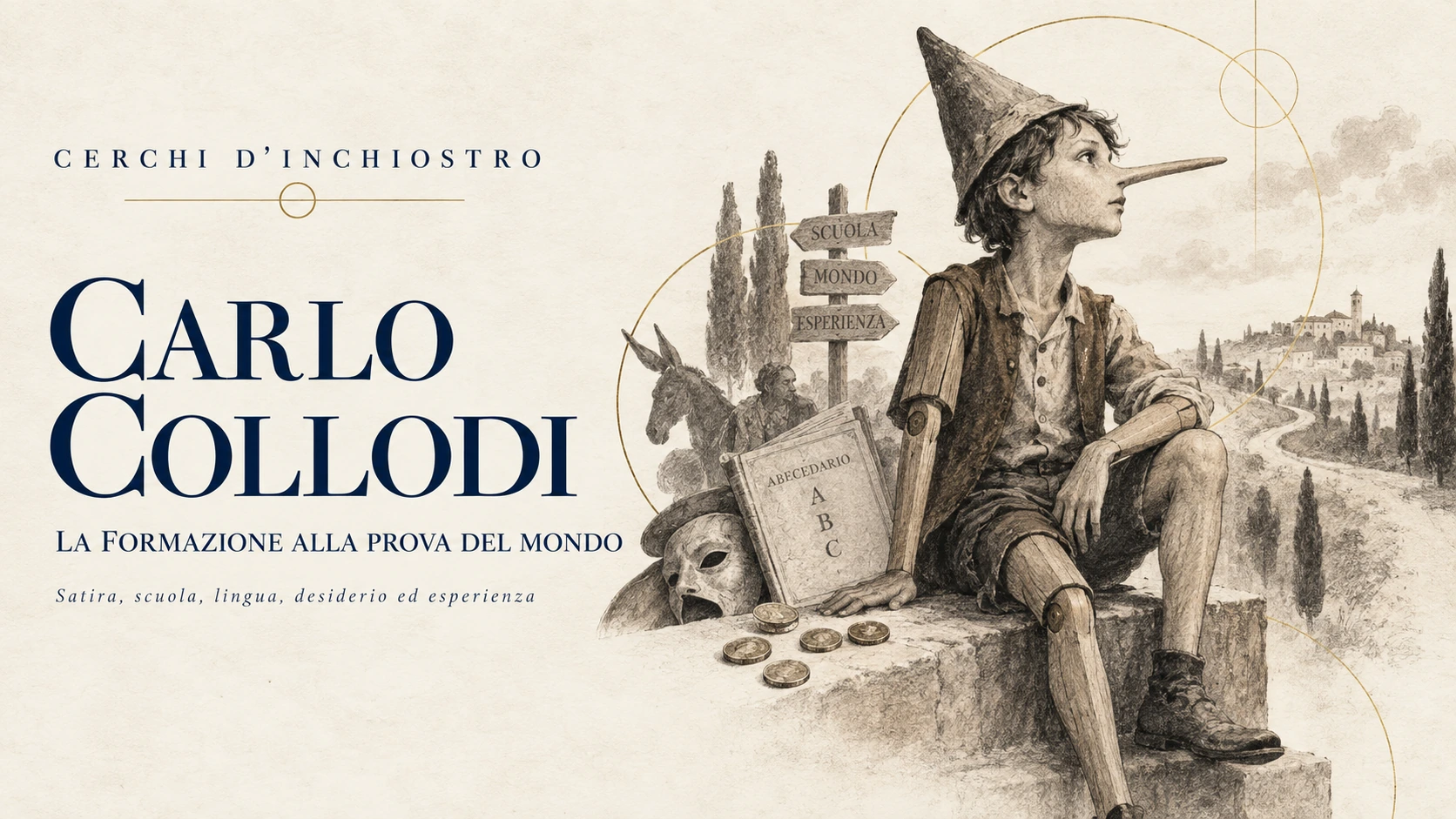
Carlo Collodi — the pen name of Carlo Lorenzini (1826–1890) — is internationally remembered for Pinocchio. The familiarity of the character can hide the severity of the book.
Pinocchio is surrounded by advice, but advice is never enough. He learns in contact with temptation, hunger, work, spectacle, deception, affection, punishment and risk. Formation takes place in a world already structured by incentives.
The guide therefore reads Collodi through one question: how does a person learn to judge when desire reaches the body before moral instruction reaches the mind?
Collodi in five minutes
Journalist, satirist, translator and writer for children, Collodi participated in the cultural world of post-unification Italy. Le avventure di Pinocchio grew from serial publication beginning in 1881 and reached book form in 1883.
The story belongs to children’s literature, but it is also a social laboratory: school, work, poverty, spectacle, authority, fraud, family and aspiration all compete to educate the protagonist.
Formation happens in encounters
Pinocchio does not move from ignorance to knowledge through a linear curriculum. He repeatedly understands a rule and still fails to act on it. This is precisely what makes the book psychologically sharp.
Learning is embodied. Hunger changes priorities. Applause changes judgment. Fear changes alliances. Affection can become credible only after repeated tests. Formation is therefore a sequence of encounters between desire and consequence.
Desire is not the enemy — but it can be governed
Collodi’s world is full of attractive shortcuts: entertainment without effort, wealth without work, freedom without responsibility. The Fox and the Cat are effective because they do not impose an external desire; they attach themselves to one already present.
The problem is not that Pinocchio wants. It is that wanting can be captured by whoever understands the immediate incentive better than he does.
Adults, institutions and inconsistent authority
The adult world is not morally uniform. Geppetto’s care, the Fairy’s discipline, school, police, judges, employers and tricksters offer different and sometimes contradictory models of authority.
This prevents Pinocchio from becoming a simple sermon about obedience. A child must learn not only to follow rules, but also to distinguish which authorities deserve trust.
School, work and becoming capable
The book belongs to a historical moment in which mass schooling, national integration and the ethic of work carried enormous civic weight. Yet Collodi continually shows the friction between these ideals and material reality.
Becoming capable takes time. Effort is not glamorous; it competes with spectacle and fantasy. The educational problem is therefore temporal: can a person tolerate the delay required for competence?
What does it mean to become “real”?
The final transformation into a “real boy” is often treated as the reward for obedience. A richer reading sees it as the outcome of acquired reciprocity: Pinocchio becomes able to care, work, delay gratification and understand himself as part of relations that have consequences for others.
The ending does not erase the wooden puppet. It retrospectively reveals how much formation required repeated failure.
The contemporary wound
Collodi becomes unexpectedly current in environments designed around instant reward. When interfaces, entertainment and commercial systems learn to capture attention before a person has learned to govern it, education cannot remain only a matter of explicit instruction.
The decisive question is not simply what we teach, but which environments rehearse desire every day.
Primary texts and orientation
Primary orientation: Carlo Collodi, Le avventure di Pinocchio. Storia di un burattino (1883) and the serial Storia di un burattino (from 1881), with reference to Collodi’s broader educational writing including Giannettino.
This English edition treats Pinocchio as a formation narrative without reducing its irony and social ambiguity to a moral handbook.
Continue reading
The triad: who — and what — forms a people?
Read this guide as one node in the Manzoni–Collodi–Pasolini triad, where shared language, lived formation and environmental pedagogy meet.