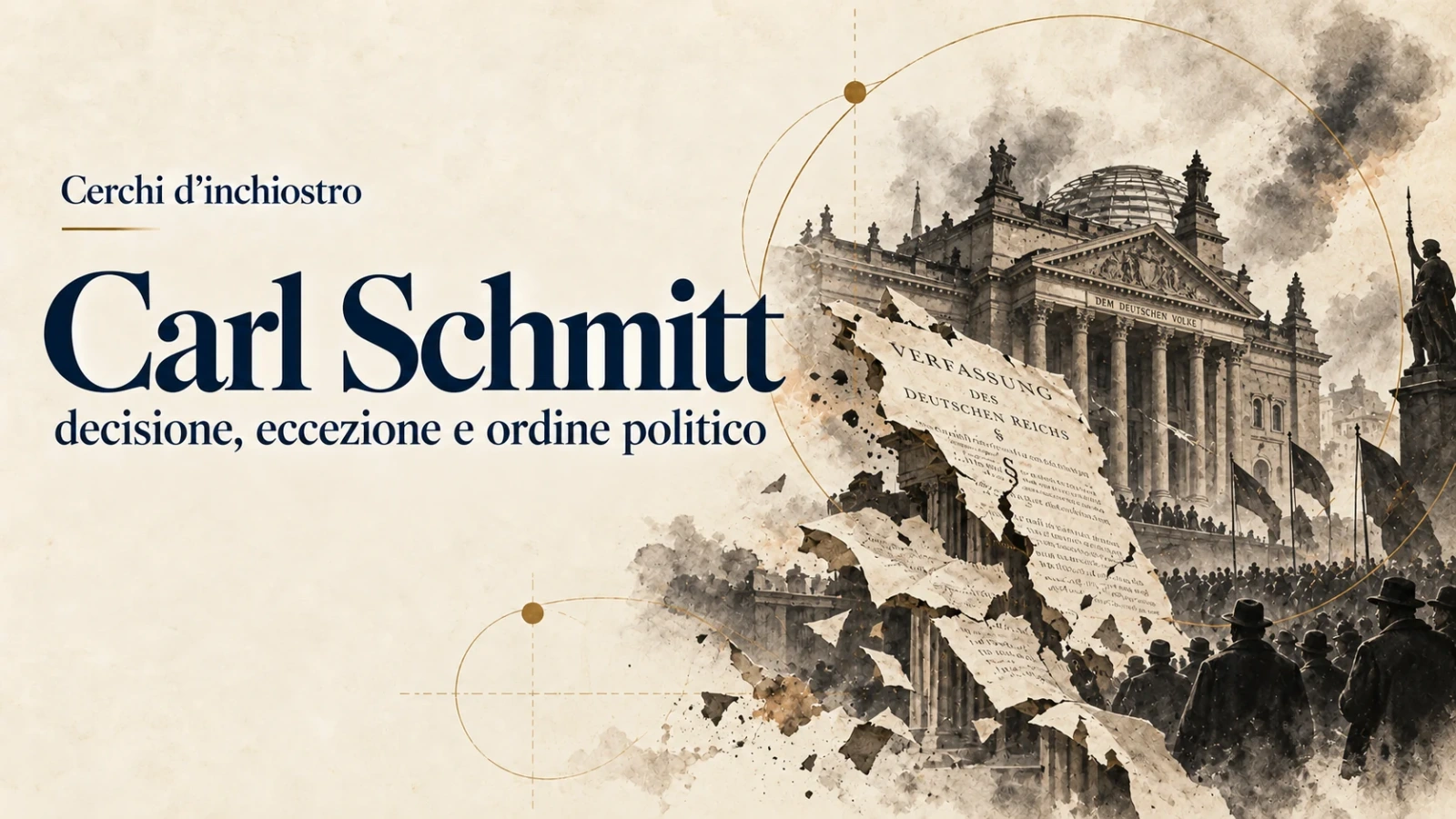
In July 1932, the German government used emergency powers to remove the government of Prussia. The dispute reached a court. Carl Schmitt, already a leading theorist of sovereignty, argued on behalf of the Reich. What might look like a technical dispute over constitutional authority revealed a deeper question: who may act in the name of an order when that order is in danger?
The question runs through Schmitt’s work and through his political choices. Who decides that normal rules no longer suffice — and who can judge the person claiming that authority?
Carl Schmitt in five minutes
Carl Schmitt (1888–1985) was a German jurist and political theorist whose most influential writings emerged from the crisis of the Weimar Republic. In Political Theology (1922) he defined sovereignty through the decision on the exception. The Concept of the Political (first published in 1927, developed in 1932) examined the distinction between friend and enemy. His books on dictatorship, constitutional theory and legitimacy explored the foundations of state authority.
His biography cannot be detached from those ideas. Schmitt joined the Nazi Party in May 1933, helped provide legal arguments for the regime, defended Hitler’s extrajudicial killings in 1934 and promoted antisemitic exclusion. He lost influence within the regime in 1936 but did not become an opponent of Nazism. After 1945 he continued writing outside university life.
Weimar: the constitution under strain
The Weimar Constitution of 1919 divided authority among institutions while Article 48 provided exceptional presidential powers under specified conditions and parliamentary controls. Economic collapse, political violence and unstable governments made presidential action increasingly central after 1930. Schmitt argued that the fragmented party system could no longer adequately safeguard political unity.
His dispute with other constitutional thinkers concerned who should guard the constitution and how far emergency action could go. During the Preußenschlag of 1932, the question entered the courtroom. Weimar offered several competing responses to institutional breakdown; its authoritarian outcome cannot be treated as the inevitable conclusion of constitutional crisis.
The exception: where the rule meets its limit
Ordinary legal rules name competent authorities, prescribe procedures and make decisions open to review. Schmitt insisted that their application presupposes a sufficiently stable situation. When that background fails, a rule may be unable to determine by itself whether an emergency exists or what must be done. In Political Theology, this is where he locates the sovereign decision.
The diagnosis identifies a difficult problem. It does not establish that whoever declares an exception is entitled to govern without restraint. Modern constitutional systems may regulate emergency powers, duration and scrutiny; Schmitt doubted that such rules could settle the extreme case completely. The crucial distance is between recognizing a limit of legal rules and authorizing unlimited political power.
A closer look · The threshold of the exception
When does a rule cease to decide?
Two conditions of the legal order. Switch perspectives to see the question Schmitt raises — and the limit his answer leaves exposed.
The critical distinction: diagnosing a crisis does not authorize unaccountable rule. Schmitt's own service to Nazism makes the political consequences of that confusion impossible to evade.
Editorial representation of the problem in Political Theology (1922); an interpretation rather than a historical diagram. Ordinary legal emergency powers need not entail a suspension of constitutional accountability. Both views remain available in print.
Two kinds of extraordinary power
In Dictatorship (1921), Schmitt distinguished a commissarial dictatorship, which claims temporary powers to defend or restore an existing constitution, from a sovereign dictatorship, which seeks to establish a new constitutional order. The distinction concerns the direction of power, beyond the promises made by its holder.
A regime may invoke preservation while transforming the very institutions it says it protects. Reading an emergency requires attention to its purpose, the duration of exceptional measures and the possibility of effective review. The 1921 distinction and the account of sovereignty in 1922 are related but not identical theories.
The political: friend and enemy
Schmitt's criterion of the political is the possibility of an intense public antagonism between groups: friend and enemy. The public enemy, hostis, differs from a private adversary, inimicus. For Schmitt, the extreme possibility of war marks the seriousness of this distinction; it does not mean that political life must consist of constant fighting.
The danger lies in who gains the authority to identify an enemy. A political opponent may be recast as a threat to collective existence, and disagreement as disloyalty. Schmitt's criterion illuminates the escalation of conflict while giving cooperation, compromise and pluralism too uncertain a place in the account of political life.
Can legality destroy its own foundations?
In Constitutional Theory (1928) and Legality and Legitimacy (1932), Schmitt separated the fundamental political character of a constitution from its individual rules. He feared that procedures could be used by forces seeking to eliminate the constitutional order that made those procedures possible. The events of 1933, however, involved intimidation, repression and violence; the Nazi seizure of power was no ordinary peaceful exercise of electoral majority.
Hans Kelsen proposed constitutional adjudication as a safeguard against political power. Hermann Heller insisted that law depends on social and political conditions while resisting Schmitt's authoritarian conclusions. Their disagreements reveal genuine alternatives: acknowledging political conflict does not require concentrating final authority in a single office.
Unity, representation and exclusion
Schmitt distinguished democracy, in his sense of the people's political identity, from liberal guarantees and parliamentary debate. His idea of democratic homogeneity allowed for acclamation and plebiscitary forms of legitimacy. Already in his pre-1933 writing, the demand for homogeneity could lead towards the exclusion of those designated as different.
Institutions also represent people whose voices and interests remain divided. No authority can safely claim that it embodies the whole community without remainder. The pluralist question left unresolved by Schmitt is whether political unity can survive persistent disagreement while preserving the rights of those who dissent.
1933–1936: the historical test
Schmitt's collaboration with National Socialism was active and public. After joining the Nazi Party in 1933, he helped interpret the new order through the leadership principle. In 1934 he offered a legal defence of the killings ordered by Hitler during the Night of the Long Knives. In 1936 he organized an antisemitic gathering aimed at excluding Jewish thinkers from German legal scholarship. These actions were political interventions carried out with professional authority.
His later loss of Nazi offices followed internal attacks; he retained his university position and a Prussian state councillor's title. It was not an act of resistance. Scholars continue to debate the precise connections between his earlier arguments and his Nazi commitments. The documented conduct itself admits no ambiguity: the authority claimed to protect an order was invoked to justify persecution and violence.
After the state: space and the changing enemy
In The Nomos of the Earth (1950), Schmitt examined the territorial foundations of international legal order: appropriation, boundaries and the spatial distribution of power. His account of Europe's historical restraint of interstate war requires a counter-history of colonial conquest and violence beyond Europe. The existence of an order does not by itself establish its justice.
Theory of the Partisan (1963) turned to irregular fighters and changing forms of enmity. The subject opens a passage to Clausewitz, whose distinct problem concerns the conduct of war, friction and the relation between military force and political purpose. Schmitt asks how antagonism becomes politically decisive; Clausewitz examines what follows when force is employed.
The contemporary wound
A community may need urgent action to survive an emergency. Yet the authority declaring a crisis also influences what counts as normal, who is deemed dangerous and when exceptional measures end. Emergency powers require publicly intelligible grounds, time limits, legal review and political responsibility if protection is to remain distinguishable from domination.
Schmitt's challenge is worth confronting because institutions can fail under pressure. His own political history shows the grave cost of granting the deciding power the last word about its own legitimacy. Who can challenge the definition of an emergency — while there is still an order worth protecting?
Primary texts and orientation
Read Carl Schmitt, Dictatorship (1921); Political Theology (1922); The Concept of the Political (1927/1932); Constitutional Theory (1928); Legality and Legitimacy (1932); The Nomos of the Earth (1950); and Theory of the Partisan (1963). His Nazi-era writings, including State, Movement, People (1933) and his 1934 defence of Hitler's killings, are essential historical documents rather than dispensable footnotes.