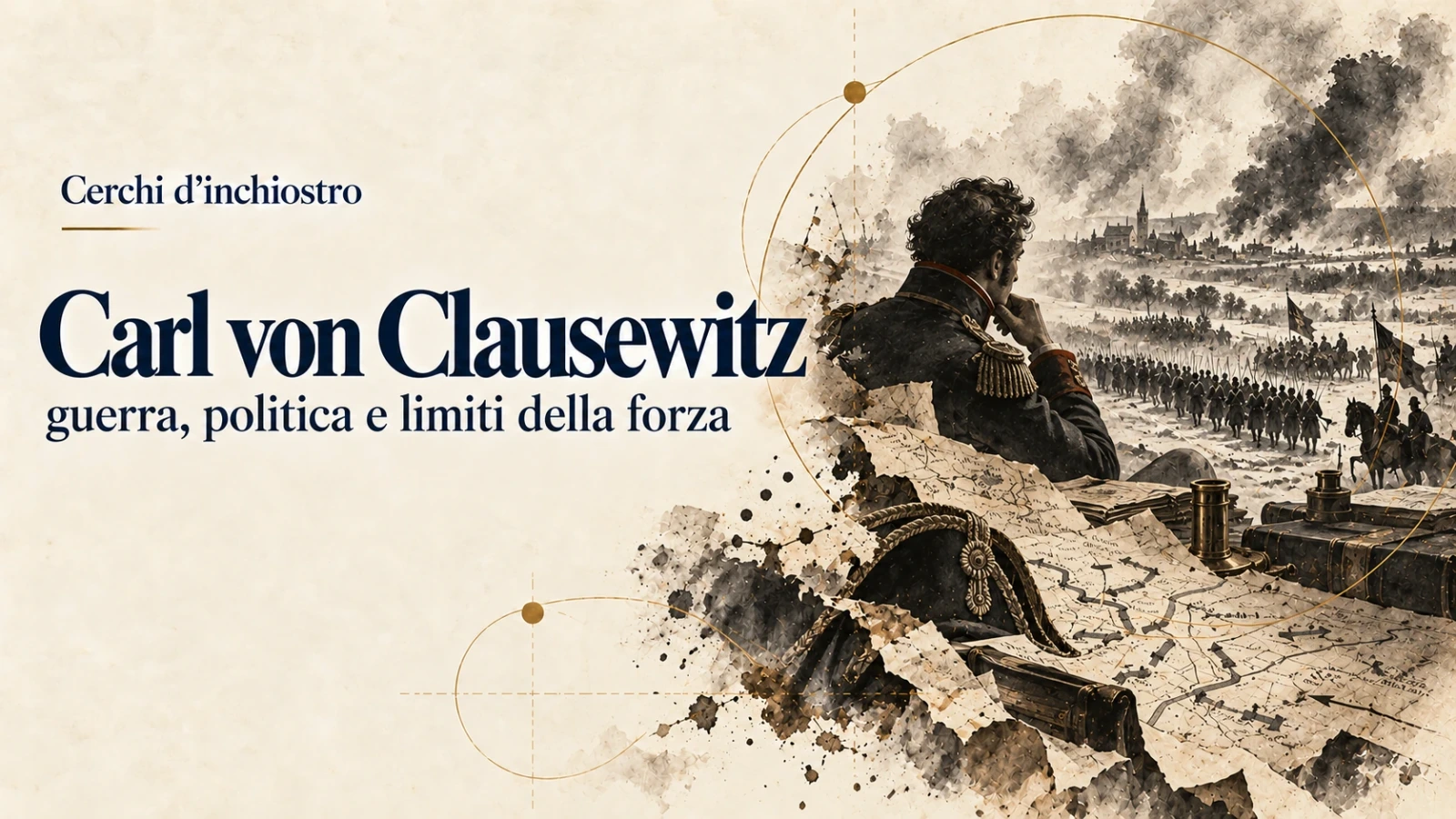
A government may set out to compel an opponent, gather an army and draw a convincing line across a map. Once the forces move, another will begins to answer. Orders arrive late. Men tire. Alliances shift. Even victory can leave the purpose of the war unresolved.
Carl von Clausewitz spent his life thinking through that distance between political intention and what armed force can bring about. What becomes of a decision when the means chosen to carry it out begin to change the world in which it made sense?
Clausewitz in five minutes
Carl Philipp Gottlieb von Clausewitz (1780–1831) was a Prussian officer and theorist shaped by the wars of Revolutionary and Napoleonic Europe. He witnessed Prussia's defeat in 1806, worked in military reform, entered Russian service in 1812 rather than support Napoleon, and served as a staff officer during the 1815 campaign, including the fighting around Wavre. He did not command the battle of Waterloo.
His principal work, On War (Vom Kriege), appeared posthumously in 1832–34 through the editorial work of Marie von Clausewitz. The eight-book manuscript was unfinished and unevenly revised. It offers a demanding way of thinking about war, rather than a completed handbook promising victory.
Political purpose, military means
Clausewitz understood war as part of a continuing political relationship. The German Politik may suggest both politics as a field of relations and policy as an orientation of action. Reducing his argument to orders passed from politicians to soldiers conceals its force: the political object gives military action meaning, while war itself can alter what that object is worth or make it impossible to attain.
A political purpose might be a negotiated concession, a change in security arrangements or a territorial settlement. A military aim might be to defeat a force or occupy a position. The two are connected but never identical. A battle can succeed on its own terms while leaving its political purpose further away.
Friction: the plan encounters the world
On paper, a march follows a timetable and an instruction reaches its destination. In war, fatigue, broken communications, illness, fear, weather and countless small delays accumulate. In Book I, Chapter 7, Clausewitz calls friction the difficulty that separates what looks simple in a plan from what people can actually do.
Uncertainty is related, but distinct. Reports may be unreliable or contradictory even before anyone attempts to act. Better information can reduce some errors without abolishing resistance, chance or exhaustion. Friction is a property of real action, not a temporary defect awaiting the perfect administrative system.
A closer look · Purpose and the changing war
Can a victory still serve its purpose?
A political purpose guides the choice of military means. War brings another will, friction and unforeseen consequences into the relationship.
The distinction that matters: operational success is not proof of political success. A possible settlement must also be judged on grounds beyond military effectiveness.
An editorial interpretation of *On War*, especially I.1, I.7 and VIII.6. The two views describe a conceptual relationship, not an actual campaign or a formula for predicting victory. Both remain available in print.
Why real war resists the extremes of theory
In the opening of On War, two opposing wills appear capable of driving each other towards ever more extreme uses of force. Clausewitz deliberately follows that abstract logic, then returns to historical wars that unfold over time, with limited resources, different political aims and adversaries capable of adaptation.
His discussions of absolute war and war considered in the abstract belong to different layers of an unfinished manuscript; scholars dispute how closely the terms should be aligned. Neither is a simple endorsement of indiscriminate violence, and neither should be equated without qualification with twentieth-century total war.
The remarkable trinity
Clausewitz described war as an interplay of three tendencies: elemental violence and passion; chance and probability; and its orientation towards political purposes. He associated these especially with the people, the commander and army, and government. The tendencies are the central idea. The institutions are historical expressions, not fixed containers that can never exchange roles.
A government may be moved by passions, a population may change its expectations, and battlefield chance may alter political calculations. The character of a war emerges from the shifting balance among these forces. No one element gives a complete account of the whole.
The culminating point of success
An army that advances may gain ground while losing the strength to hold it. Supply routes lengthen, defenders reorganize, and the purposes of conquest become harder to achieve. Clausewitz's culminating point names a threshold beyond which continued success can undermine the advantage already won. He also treated defence as inherently stronger than attack under comparable conditions, without describing it as passive.
The centre of gravity is another demanding concept: it asks where an opponent's effective cohesion is concentrated. It is not a universal checklist of targets. The question of where to concentrate effort must be joined to the more difficult question of when effort has begun to defeat its own purpose.
Judgment, morale and the resistant enemy
Clausewitz distinguished tactics, the use of forces in combat, from strategy, the use of engagements for the purposes of war. Both depend on human qualities: courage, endurance, judgment under pressure and what he called coup d'œil, a practiced capacity to grasp a difficult situation quickly.
These are not guarantees of mastery. An enemy has intentions of its own, while soldiers and civilians endure the consequences of decisions they do not fully control. Clausewitz examined popular resistance and irregular war as well as regular armies. Superior force in a battle does not necessarily resolve an occupation or secure the desired political settlement.
The peace by which victory is measured
The political meaning of a military result is revealed by what can follow it. Territory may be taken but remain impossible to hold; a force may be defeated while its government refuses the terms sought. A limited political object can sometimes be pursued through limited military aims, though limited aims do not by themselves make a war humane.
For Circles of Ink, the possible peace is a test of the claimed victory. This is our editorial reading of Clausewitz's distinction between political ends and military means, not a quotation or a theory of just peace supplied by him. A settlement may be strategically coherent while remaining morally or legally indefensible.
An unfinished work and its readers
Clausewitz left notes in 1827 about revising On War, especially its account of wars seeking an opponent's overthrow and wars pursuing more restricted political ends. Another note, of uncertain date, suggests that much of the manuscript remained provisional. The sequence and significance of these notes are disputed; no single passage should be treated as a final key to every book.
Marie von Clausewitz organized and introduced its publication after his death. Later interpreters have sometimes turned the work into a doctrine of decisive battle, while others have emphasized limited aims, uncertainty and the changing relation between war and politics. Reading the arguments within the manuscript matters more than inheriting a simplified 'Clausewitzian' slogan.
The contemporary wound
New technologies may make a battlefield more visible without making the political outcome more predictable. Conflict can expand its aims, consume resources and create obligations no one anticipated when force was first chosen. The opponent's response remains a political fact, not merely an obstacle to a technical solution.
Clausewitz offers no theory of contemporary humanitarian law or a prediction of drones, cyber operations or nuclear deterrence. His enduring challenge is one of judgment: can those who continue a war still say what political relationship their use of force is capable of bringing about?
Primary texts and orientation
Begin with Clausewitz, On War: Book I, Chapters 1, 3, 6–7 (nature of war, judgment, information and friction); Book II, Chapter 1 (tactics and strategy); Book VI (defence); Book VII (the culminating point); and Book VIII, especially Chapters 2, 4 and 6 (forms of war, concentration and political purpose). Consult the author's notes on revision and Marie von Clausewitz's preface when assessing the unfinished text.
Read the entire eleventh triad in English: from Thucydides' crisis of civic judgment through Schmitt's sovereign claim to Clausewitz's question of force and political purpose.