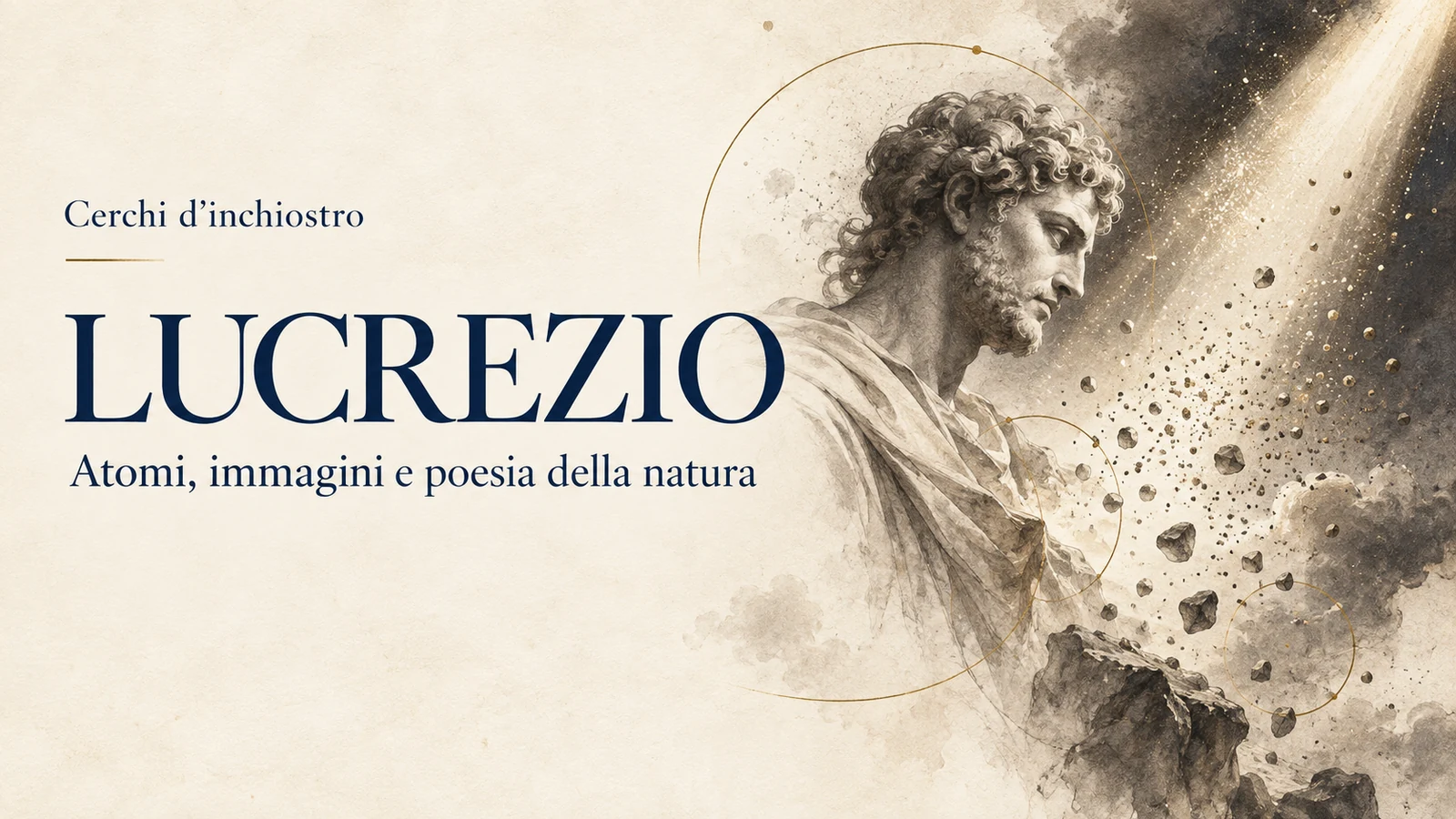
A shaft of sunlight enters a darkened room. Tiny specks become visible in the light, moving in restless, unpredictable ways. They had been there before the window made them apparent. The light has altered what an observer can see.
Lucretius pauses over such a scene in the second book of De rerum natura. The specks are grains of dust, not atoms. Their motion offers an analogy for a movement too small for the eye to follow. A familiar incident becomes a passage from what can be observed to what must be inferred.
That passage is the great labour of his poem. Wind, scent, wounds, desire and the changing surfaces of things lead the reader towards a world composed of bodies and void. Lucretius asks his audience to imagine a nature that produces us without being designed for us. To make the argument intelligible, he entrusts it to poetry.
How can a material world become knowable through images without mistaking the images for the world itself?
Lucretius in five minutes
Titus Lucretius Carus lived in the first century BCE, towards the end of the Roman Republic. Almost nothing about his life can be established securely. In a letter to his brother in 54 BCE, Cicero mentions Lucretius' poems; the famous account of madness, a love potion and suicide comes from the much later Jerome and cannot be treated as verified biography.
His surviving work, De rerum natura (On the Nature of Things), is a six-book philosophical poem in Latin hexameters, addressed at points to a Memmius generally identified with the Roman politician Gaius Memmius. Its principal intellectual source is Epicurus. From Epicurean philosophy Lucretius draws the material constitution of the world, the mortality of the soul and the hope that explaining natural phenomena can loosen the grip of fear.
The poem's six books survive substantially complete, although many scholars think Lucretius did not give them a final revision. Its structure remains unmistakable: books I–II concern atoms and void; III–IV turn to the soul, sensation and thought; V–VI widen the inquiry to the world, civilization and natural phenomena.
Atoms and void: what things are made of
For Lucretius, things come into being through combinations of first bodies and pass away when those combinations dissolve. Nothing arises from nothing, and nothing simply vanishes into nothing. The void makes motion and encounter possible. Atoms and void belong to an ancient philosophical physics; their terms should not be silently equated with those of contemporary particle physics.
Since the first bodies are imperceptible, Lucretius works from visible effects. The wind moves trees without appearing as an object to the eye. Clothes wear thin by degrees. Scents travel across a room. The world we encounter becomes a source of clues about processes we cannot directly inspect.
The implications reach beyond matter. An environment shaped by combinations and dissolutions has no need of a divine craftsman preparing everything for human use. Nature can sustain life and destroy it. Understanding a cause does not make it benign.
The sunbeam: what an analogy can show
In book II, around lines 114–141, dust motes dance in a beam of light. Lucretius offers them as an example through which the mind can picture unseen collisions and ceaseless movement. The point depends on a difference in scale: the visible grains are themselves composite bodies.
There is intellectual generosity in this gesture. He begins with a scene available to nearly everyone, then asks the reader to pass beyond it. There is also a limit. The dust is no experimental demonstration of atomic theory, still less an anticipation of modern accounts of Brownian motion. It is an image that helps an argument become imaginable.
The distinction matters throughout the poem: observation, inference and poetic representation work together, while remaining different activities.
A closer look · The sunbeam, Book II
What can the light actually show?
A beam of sunlight makes dust visible. Lucretius uses that ordinary movement to help the reader imagine something far smaller.
The limit matters. Dust motes are not atoms, and this ancient analogy is not a modern laboratory observation of Brownian motion.
Original editorial interpretation of *De rerum natura* II.114–141. The two views distinguish a visible example from the explanatory inference made through it. Both remain legible in print.
The swerve and the difficulty of freedom
An atom falling forever along a strictly parallel path would never meet another. Lucretius introduces a minute, indeterminate deviation in atomic movement in book II (216–293), known in later discussion as the clinamen. It helps explain how collisions become possible, and he connects it to the voluntas of living creatures, their capacity to initiate movement.
That connection has produced centuries of disagreement. A deviation in an atom's trajectory does not, by itself, provide a complete explanation of a person's responsible action. The exact relation between swerve, necessity and willing remains contested within scholarship on Epicurean freedom.
Lucretius is worth reading at the site of that difficulty. His materialism seeks to avoid an unbroken chain of necessity without locating human agency outside nature.
The body, the soul and the fear of death
In book III, the soul belongs to the physical life of the body. Animus and anima are conceived as material and mortal. When their organization breaks apart, the person does not continue as a spectator of that loss.
Death is therefore a peculiarly difficult object for imagination. We picture the world after our departure and quietly insert ourselves into the picture to witness our own absence. Lucretius tries to interrupt this fiction. He asks the reader to consider the untroubled time before birth as a counterpart to the time after death.
The argument is offered as a treatment for fear. It cannot abolish bereavement or the suffering of bodies still alive. It seeks to remove an added terror: the thought of one's own non-experience as an experience to be endured.
Simulacra: how a world reaches the senses
Book IV describes simulacra, extraordinarily fine material films emitted from bodies and implicated, in the Epicurean account, in sight, dreams and mental images. Other senses are explained through other forms of material contact or emanation. The model is historically specific and scientifically obsolete.
Lucretius distinguishes the appearance registered by a sense from a judgment added by the mind. A distant tower may look round and appear angular on approach. In Epicurean epistemology, sensation is treated as true in a technical sense: it gives the appearance as experienced under particular conditions. Our conclusion about the object can still be mistaken.
The simulacra are neither messages nor digital media. They belong to an ancient theory of physical perception. Their continuing philosophical interest lies in the question they make sharp: what happens between the existence of a body and its becoming experience for another body?
Why a materialist writes poetry
Lucretius makes Greek Epicurean philosophy speak in Latin, a language he describes as lacking ready equivalents for some of the concepts he must convey. The difficulty is part of the work. He is fashioning the words through which the argument can be received.
His famous comparison of philosophy to bitter medicine offered at a honeyed cup appears in book I and is taken up again in book IV. Verse holds the reader's attention long enough for a difficult teaching to take effect. The image is generous and unsettling at once: persuasion has a technique, and its success partly depends on the reader's susceptibility to form.
Even the Latin word elementa can suggest both the first components of matter and the letters from which words are arranged. In book I, Lucretius brings differently ordered letters into his account of differently combined bodies. The poem allows its own material signs to illuminate its argument. Analogy is doing intellectual work, although it does not become proof of atomism.
Venus, the gods and a world without a recipient
A poem devoted to non-providential nature opens with an invocation to Venus. The goddess brings life and desire into the first lines and is asked to quiet Mars. The scene is difficult to flatten into a single allegory. Epicurean physics rejects divine intervention in human affairs, while Lucretius draws on a rich Roman and Greek poetic inheritance, including the precedent of Empedocles.
Later, the story of Iphigenia's sacrifice exposes the terrible power of religio when imagined divine demands overrule human obligations. Lucretius does not simply articulate modern atheism. Epicurean gods are not the managers of storms, harvests, battles or punishment.
His harder proposal is that events do not need a human addressee. A thunderstorm is not necessarily a warning; disease need not be a verdict. Once causation is separated from imagined intention, nature becomes less flattering to us and more available to understanding.
Civilizations emerge; their power remains ambivalent
In book V, language, tools, dwellings and institutions arise through natural capacities, need, practice and collective development. No single inventor is required to name every object or design society from the beginning. Human arrangements have histories.
Those histories do not constitute an uncomplicated ascent. Metals permit agriculture and warfare. Settlements bring cooperation and contest over power. New resources generate new possibilities as well as new desires. Material invention cannot decide, by itself, what deserves to be pursued.
The poem belongs to Roman culture while allowing its readers to imagine civilization without a providential script.
The plague at the end
Book VI ends with the plague of Athens, drawing recognizably on Thucydides' account of the epidemic in the History of the Peloponnesian War. The sequence is severe: bodies fail, care becomes precarious, and the civic ties that ordinarily make a city possible are strained.
We should not turn the ending into a neat moral victory for Epicurean therapy. Nor does it settle the literary problem of whether Lucretius completed his final revisions. The plague leaves a harder lesson beside the poem's vast explanatory ambition. Understanding nature cannot exempt a body from what nature does.
Knowledge may free us from imaginary causes and punishments. It cannot promise immunity.
The contemporary wound: the illusion of immateriality
A message seems to cross the world without weight. A cloud service answers almost instantly. Yet the apparent ease depends on devices, electricity, cables, servers, cooling systems, extraction and human work. These examples belong to our age, not to Lucretius' scientific horizon.
What his method offers is the discipline of asking after the material conditions of an appearance. It is also why this triad needs three distinct authors. Lucretius concerns bodies and the conditions of perception; Marshall McLuhan will ask how media reshape the environment in which perception occurs; Claude Shannon will delimit what can be transmitted through a channel under formal constraints. Those are different inquiries, brought together editorially rather than folded into one theory.
The first movement is Lucretius': look carefully at what appears, then investigate what makes the appearance possible. A world does not have to be speaking to us for us to learn how to read it.
Primary texts and orientation
Primary orientation: Lucretius, De rerum natura, especially I.1–101, I.136–148, I.907–950, II.114–293, III, IV.26–521, V and VI; Epicurus' Letter to Herodotus and Letter to Menoeceus; Cicero, Ad Quintum fratrem II.10(9).3; Jerome's Chronicon (a late and unreliable biographical tradition); and Thucydides, History of the Peloponnesian War II.47–54.
Read the tenth triad as a tension between the material world, the environments through which we encounter it and the formal conditions of transmission.