Introduction
Condorcet brings mathematics, education and republican politics into the same problem: a community must decide even though its citizens have incomplete information, unequal knowledge and sometimes conflicting preferences.
The Italian guide therefore places judgment before procedure. A vote can aggregate choices, but the quality of the result depends on education, independence, information and the structure of the decision itself.
Condorcet’s freedom is institutional: people become less dependent when they can understand laws, assess evidence and revise collective decisions rather than merely receive them.
Reason must enter institutions
Condorcet does not treat reason as a private possession of enlightened individuals. The political problem is to build institutions that distribute the means of judgment and make public decisions revisable.
This is why education, voting procedures, rights and constitutional design belong to the same architecture in the source guide.
The jury theorem: when a majority can become more reliable
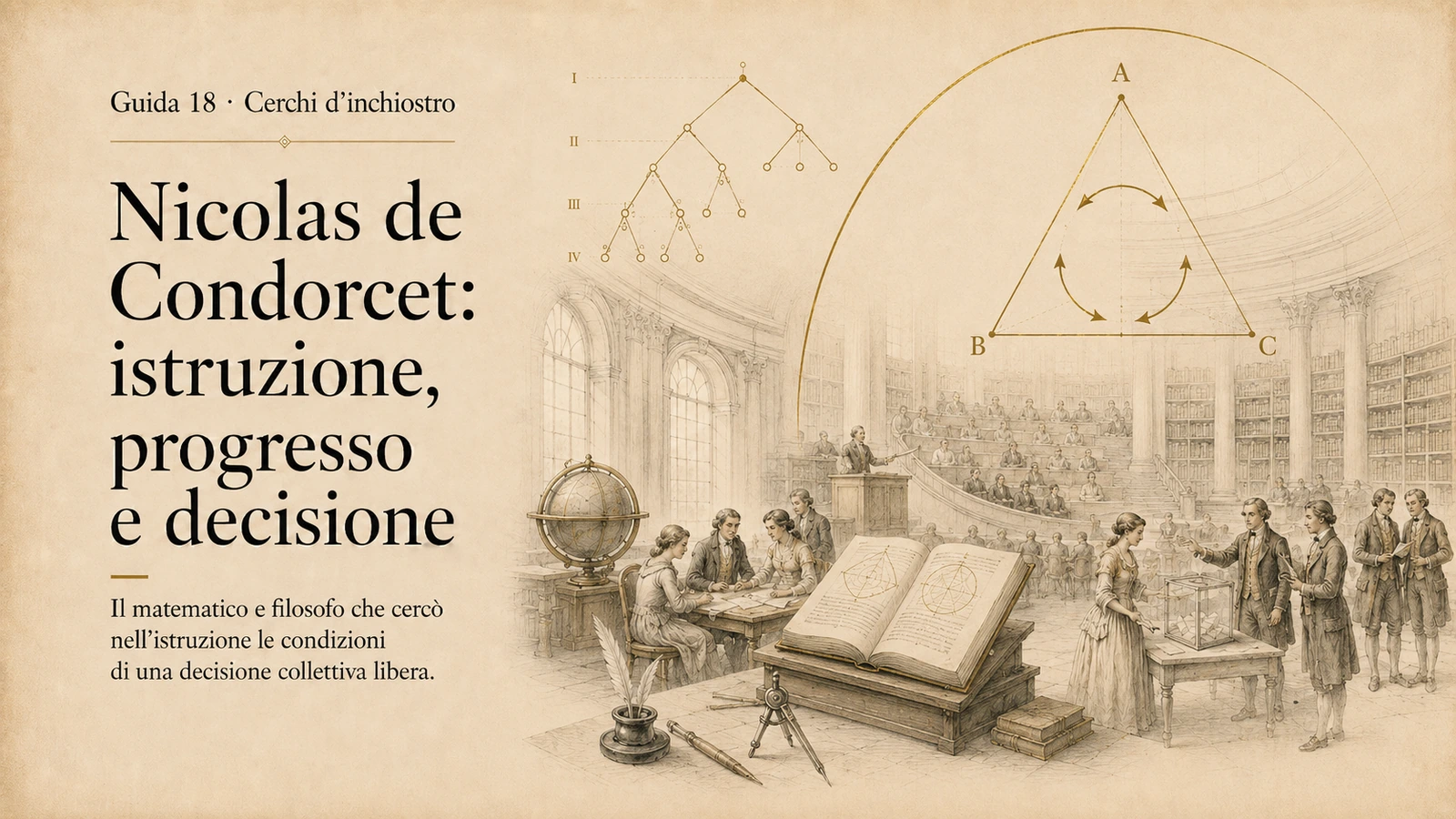
In the binary case described by the source guide, majority judgment can become more reliable than an individual judgment when each voter is more likely than chance to be correct and when judgments are sufficiently independent.
The result is conditional, not a proof that majorities are always right. Shared misinformation, correlated errors or competence below the relevant threshold can reverse the advantage.
The Condorcet paradox: a majority without a coherent will
With more than two alternatives, individually coherent preferences can aggregate into a cycle: A defeats B, B defeats C, and C defeats A.
The point is institutional rather than cynical. Agenda and procedure participate in constructing the collective outcome; they do not merely reveal a pre-existing single “will of the people.”
Education as an institution of liberty
Condorcet’s public education aims to reduce dependence. Citizens should be able to read laws, assess evidence, understand contracts and exercise rights without having to accept an authority’s interpretation on trust.
The source guide stresses lifelong education, intellectual autonomy and resistance to turning public instruction into political or religious catechism.
Progress and perfectibility
The Esquisse treats human history as capable of cumulative improvement through knowledge, institutions, rights and the transmission of learning. The guide distinguishes this from automatic optimism.
Technical progress can coexist with civic regression. Improvement requires institutions that preserve correction, criticism and the ability to transmit what has been learned.
The limits of rationalized decision
The source guide is explicit about the risks: not every political question has one correct answer; competence can become technocratic hierarchy; judgments are often correlated; and universalist progress narratives can become Eurocentric.
Condorcet’s value lies in making conditions visible, not in turning calculation into a substitute for political conflict or value judgment.
The contemporary wound: decision without judgment
Modern democracies can count with great precision while weakening the shared ability to understand what is being counted. Votes, polls, rankings and algorithmic scores can appear self-explanatory even when the informational and procedural conditions behind them are opaque.
The source guide treats AI and automated decision systems as contemporary applications, not Condorcetian prophecies. The enduring question is who forms judgment, through which sources, and with what possibility of verification and correction.
Democratic quality begins before the count, in the distribution of knowledge, and continues after it, in the right to revise an error.
Primary texts and orientation
Primary orientation follows the Essay on the Application of Analysis to the Probability of Majority Decisions, the Five Memoirs on Public Instruction, the report on the general organization of public education, writings on women’s citizenship and slavery, constitutional writings of 1792–1793, and the posthumous Sketch for a Historical Picture of the Progress of the Human Mind.
The Italian guide points readers toward Keith Michael Baker, Iain McLean and Fiona Hewitt, Élisabeth and Robert Badinter, David Williams, Emma Rothschild, Catherine Kintzler, Duncan Black, Kenneth Arrow and Amartya Sen, while keeping later social-choice developments distinct from Condorcet’s own work.
Continue reading
The triad: republic, opinion, decision.
Read this guide as one node in the Cicero–Tocqueville–Condorcet triad: three ways of asking what makes political freedom durable — a common republic, citizens capable of acting together, and procedures that turn judgment into revisable collective decision.