Introduction
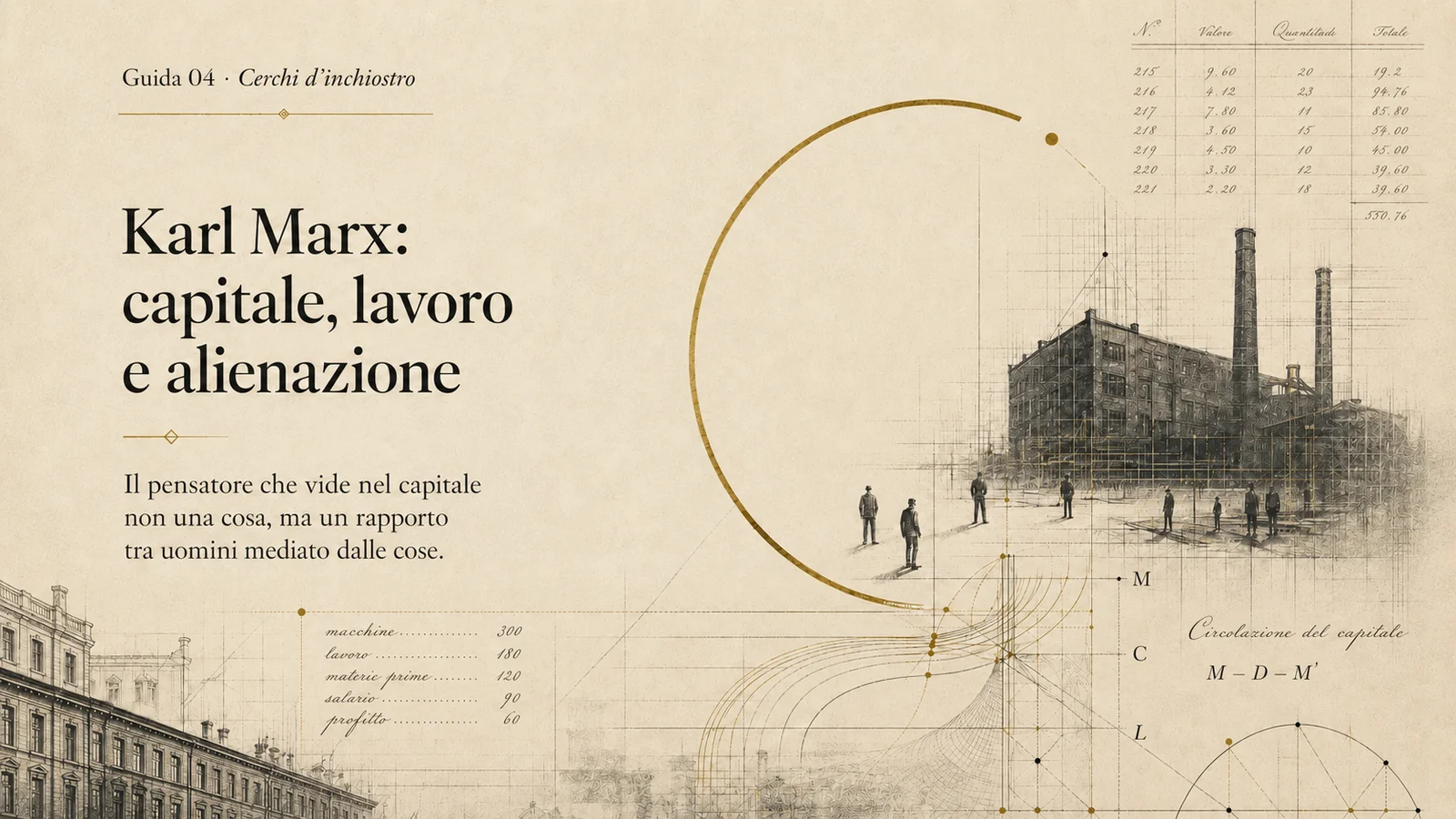
Karl Marx was born in Trier in 1818 and died in London in 1883. Philosopher, economist, journalist, historian and political theorist, he enters Circles of Ink not as an icon to celebrate or prosecute but as one of the most radical anatomists of economic modernity.
His central question is deeper than ownership alone: what happens to human beings when work, time, needs, desire and relationships take the form of commodities and value?
The Italian guide treats capitalism not simply as a production system but as a historical social form capable of organizing work, cities, class relations, consciousness and everyday life.
Marx in five minutes
Marx moves through German philosophy, French political struggle and British industrial capitalism. His major works include the Economic and Philosophic Manuscripts of 1844, Theses on Feuerbach, The German Ideology, The Communist Manifesto, The Eighteenth Brumaire of Louis Bonaparte, the Grundrisse and Capital.
Alienation, commodity, capital, surplus value, ideology, class conflict and commodity fetishism are not isolated definitions. Together they form a diagnosis: modern social relations can confront their own makers as if they were impersonal necessities.
The commodity as a modern enigma
A commodity appears simple: something useful that can be bought and sold. Marx makes it strange again. It has a use value, but under capitalism it also enters a system of exchange in which heterogeneous forms of labor become socially comparable.
This is why the commodity is more than an object. It condenses labor, time, value and social relations. In commodity fetishism, relations among people can appear as relations among things, while the human activity that produced those relations recedes from view.
Alienated labor: producing a world that stands against its maker
In the early Marx, labor should be one of the ways human beings express and build themselves. Under alienated labor, that capacity reverses: the worker is separated from the product, from the activity of work, from human potential and from other people.
The crucial point is structural rather than psychological. Alienation is not merely feeling unhappy at work. It names a relation in which what human beings produce returns to them as an external power they do not recognize as their own social creation.
Capital as a social relation
The Italian guide insists on one of Marx’s most important distinctions: capital is not simply money or accumulated wealth. Money becomes capital when it enters a process of valorization — purchasing labor power and other commodities in order to return as more value.
Behind that movement lies a social relation. Capital requires historically specific arrangements of property, labor power, production and accumulation. What looks like an autonomous movement of value therefore depends on relations among people.
Ideology and the naturalization of history
For Marx, ideology is more than explicit propaganda. A society can represent its historically specific relations as natural, eternal or technically necessary. Wages, markets, property, law or political institutions may then appear detached from the conflicts and conditions that formed them.
The critique of ideology does not require reducing all culture to economics. The Italian guide explicitly warns against that impoverished reading. The point is to ask how representations of society can conceal, invert or normalize actual relations of power and dependence.
Digital capitalism: categories, not prophecy
Marx did not predict the internet, platforms, social media, artificial intelligence or the gig economy. The source guide is explicit about this. His value lies in categories that can be tested against new conditions rather than in retroactive prophecy.
Digital life can make attention, data, reputation, availability and behavior economically valuable. The question is whether relations that appear voluntary or immaterial still contain forms of extraction, dependence and measurement that deserve Marxian scrutiny.
The contemporary wound: digital alienation
The Italian guide extends alienation cautiously into a world of platforms, ratings, cloud infrastructure, social networks and AI. The worker is no longer only the person entering a factory; productive activity can include delivery work, content, data generation, constant reputation management and the conversion of skills into permanently marketable profiles.
This alienation can be harder to see because it often presents itself as choice: when to work, what to publish, how visible to be, how quickly to respond. But choices made inside systems that reward permanent availability and adaptation to metrics deserve closer inspection.
The updated Marxian question is not whether the nineteenth century has returned, but how much of the person can become input when capital reaches attention, data, presence, image and relational time.
Primary texts and orientation
Primary orientation: Karl Marx, Economic and Philosophic Manuscripts of 1844, Theses on Feuerbach, The German Ideology with Friedrich Engels, The Communist Manifesto with Engels, The Eighteenth Brumaire of Louis Bonaparte, Grundrisse, A Contribution to the Critique of Political Economy and Capital, Book I.
The Italian guide points readers toward David McLellan, Isaiah Berlin, Étienne Balibar, Eric Hobsbawm, David Harvey, Moishe Postone, Michael Heinrich, Ellen Meiksins Wood, György Lukács, the Frankfurt School and Italian scholarship including Lucio Colletti, Roberto Fineschi and Marcello Musto.
Continue reading
The triad: capital, values, desire.
Read this guide as one node in the Marx–Nietzsche–Leopardi triad: three ways of asking how modernity organizes what we produce, what we believe and what we desire.