Introduction
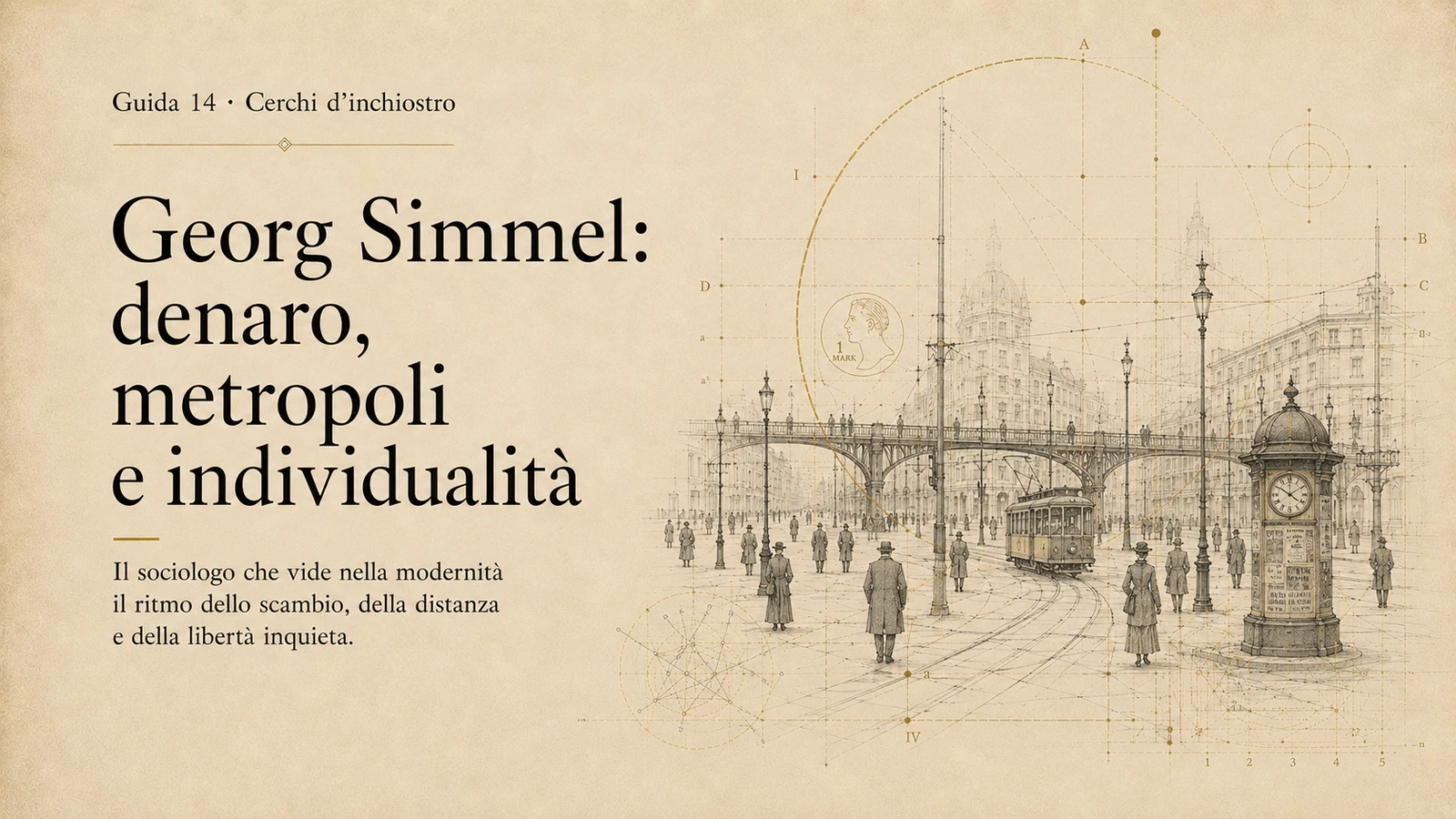
Georg Simmel (1858–1918) is a thinker of the forms through which modern life becomes possible: money, metropolitan distance, social circles, fashion, secrecy, the stranger and the expansion of objective culture.
The Italian guide frames his human problem as freedom inside abstraction. Modernity loosens inherited bonds and multiplies movement, roles and possibilities. The gain is real. So is the cost: more access does not automatically mean more meaning, and more mobility does not necessarily mean deeper belonging.
Simmel’s strength is his refusal to sacrifice either side of that ambivalence.
Money and the translatable life
Money loosens social relations from particular persons. A service can be paid for, a debt closed, a good exchanged among people who do not share family, status, memory or belief.
This impersonality can be liberating. The same mechanism also trains the world to enter common scales of comparison. Qualitatively different things remain different, but they can increasingly be translated into equivalent terms.
Value begins in distance
For Simmel, value does not simply sit inside an object. It emerges through a relation among desire, distance, sacrifice and attainability. What is entirely available may not generate tension; what is absolutely unreachable falls outside practical striving.
Exchange makes this visible. Money radicalizes the process by providing a common measure, enabling large-scale cooperation while simplifying qualities that cannot be exhausted by quantity.
The metropolis and nervous life
The metropolis intensifies stimuli, coordination, schedules, encounters and anonymity. The individual cannot respond to everything with full emotional force.
Simmel’s blasé attitude is therefore not simply fashionable indifference. It is a protective adaptation: a way of reducing psychic permeability in an environment where too much arrives too quickly.
Individuality as an intersection of social circles
Modern individuality grows as people belong to multiple circles that no single group can completely contain: family, profession, friendship, city, association, audience and interest.
This plurality weakens the grip of closed communities and enlarges personal differentiation. It can also make continuity harder to inhabit. The modern person is freer because no one circle exhausts the self, but may also feel less fully held by any one world.
The tragedy of culture
Human beings create languages, institutions, sciences, techniques, archives and markets in order to extend life beyond immediate experience. These forms can then grow faster than any individual can appropriate them.
The Italian guide calls this the tragedy of culture: objective culture expands while subjective capacity remains finite. The problem is not scarcity but excess — a world of knowledge and systems larger than the life that must somehow make them its own.
Simmel does not simply condemn modernity
The source guide rejects a nostalgic reading. Money can emancipate from suffocating personal dependence; measurement can reduce arbitrary judgment; the city can free a person from the surveillance of small communities.
Simmel’s critique becomes sharper because the gain and the loss often come from the same mechanism. Freedom and cooling, mobility and distance, objectification and emancipation can develop together.
The contemporary wound: comparable life
The contemporary wound is not measurement itself but the demand that almost everything become legible as a comparable signal: rating, ranking, profile, follower count, performance, reputation score, credential or quantified attention.
These measures can widen access and expose hidden unfairness. The problem begins when comparability becomes the dominant criterion for recognition and qualities that do not translate cleanly start to disappear from view.
The question is what happens to life when what cannot become a signal begins to look as if it has no value.
Primary texts and orientation
Primary orientation follows Simmel through The Philosophy of Money, The Metropolis and Mental Life, Sociology, Philosophical Culture, Rembrandt, Fundamental Problems of Sociology, The Conflict in Modern Culture, and essays on fashion, secrecy, the stranger and the tragedy of culture.
The Italian guide points readers toward David Frisby, Kurt H. Wolff, Donald N. Levine, Lewis A. Coser and Elizabeth S. Goodstein, while insisting that Simmel should not be reduced to the sociology of the metropolis or treated as a prophet of digital life.
Continue reading
The triad: interpretation, money, exchange.
Read this guide as one node in the Averroes–Simmel–Smith triad: three ways of asking what lets strangers share a world when meaning must be interpreted, value made comparable and exchange sustained by trust.