Introduction
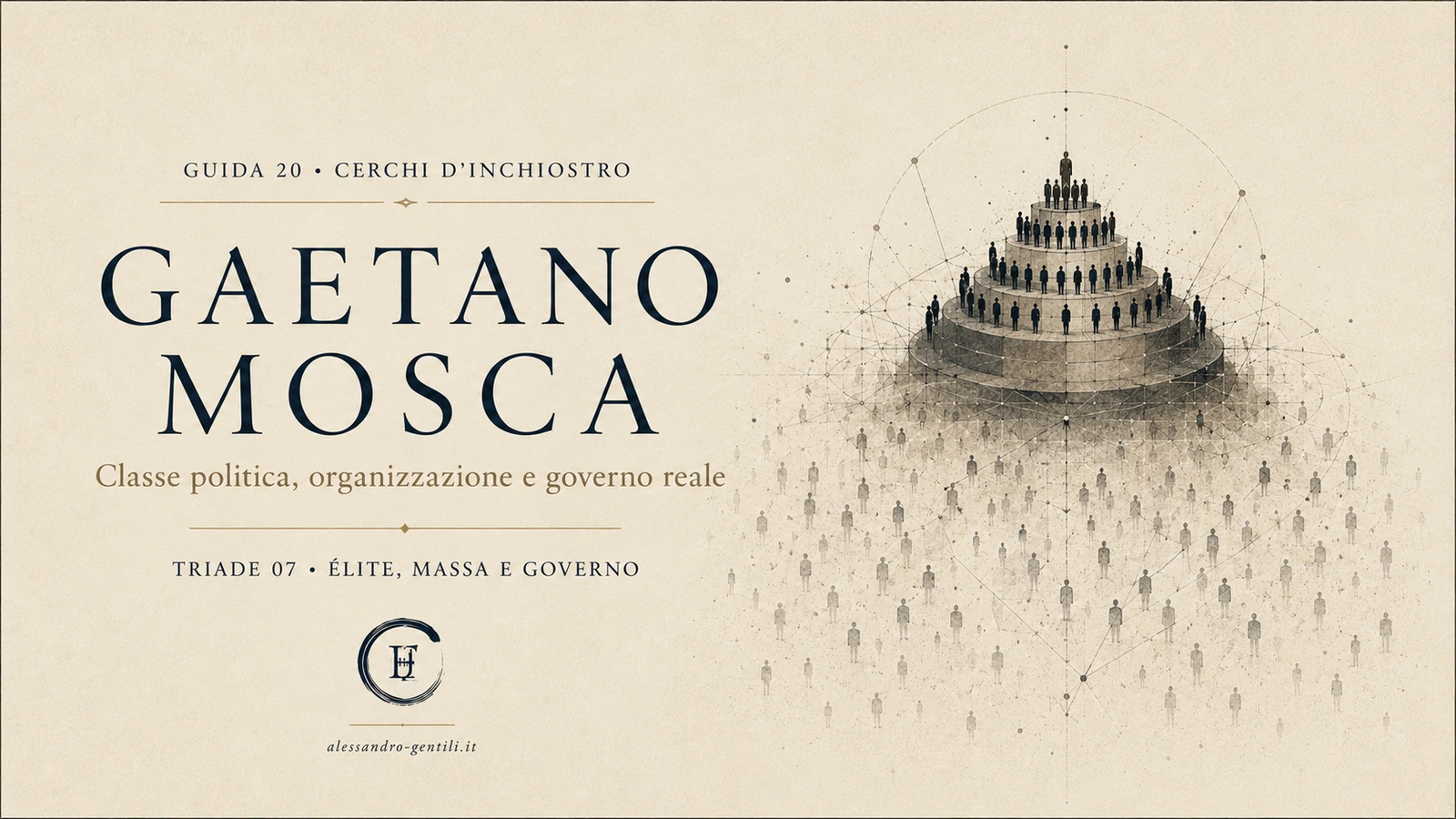
Gaetano Mosca shifts political analysis from the formal name of a regime toward the people and organizations that make government continuous in practice.
The Italian guide frames his human and political problem as a disproportion between number and action. Many people can share an interest without being able to coordinate it, while a smaller group with time, information, roles and continuity can convert organization into durable power.
The point is not that majorities are naturally inferior. It is that complex politics requires mediation — and every mediation creates positions that must themselves be limited and opened to replacement.
From forms of government to the political class
Mosca does not discard constitutions, elections or formal offices. He asks what those forms conceal if we stop at their legal description.
The political class is the minority that occupies directive positions and supplies continuity to government through officials, party leaders, administrators, professionals and other organizers. Formal sovereignty and daily command are therefore distinct questions.
Organized minority and dispersed majority
A smaller group can coordinate more easily: its members divide tasks, preserve information, discipline action and plan over time. A large public participates more intermittently and with unequal access to information.
The guide treats this as an organizational asymmetry, not a claim of natural superiority. Majorities become politically effective by generating organizations of their own.
The political formula: power needs a public justification
For Mosca, durable rule does not present itself as sheer force. It connects command to principles that make obedience morally or politically intelligible: dynasty, nation, law, popular sovereignty, competence or other legitimating ideas.
The political formula can serve those who govern, but it can also constrain them. A class ruling in the name of law or representation creates standards through which its own conduct can be challenged.
Inheritance, co-optation and renewal
Political classes tend to reproduce themselves through family, education, professional codes, networks and institutional selection. Co-optation can introduce new capacities while leaving the gatekeeping power of the old elite intact.
The source guide distinguishes succession, co-optation and genuine opening. Replacing faces does not necessarily change the channels through which command is produced.
Democracy as selection, control and replacement
Mosca’s realism rejects the image of a people that governs continuously as one undivided subject. Elections, associations, parties, press and local institutions instead create ways to select, monitor and replace governing minorities.
The source guide emphasizes a liberal implication: democratic quality depends not on the disappearance of “the few” but on whether governing groups remain visible, responsible, limited and genuinely contestable.
Legal defense and plural limits
Difesa giuridica is the point at which Mosca’s analysis distinguishes the recurring fact of minority rule from the quality of particular regimes.
The guide warns against translating it mechanically into contemporary “checks and balances.” It refers more broadly to institutional and social separations capable of preventing political, bureaucratic, economic or military power from absorbing every other force.
The contemporary wound: counting votes without seeing who organizes the choices
The source guide applies Mosca to a democracy rich in metrics but often inattentive to what precedes the count. Candidates, agendas, technical language, media visibility and policy options are shaped by organizations with unequal time, resources and continuity.
This does not require an occult center. The problem is visible organization: who can prepare alternatives, form personnel and remain present throughout the decision process.
A democracy becomes more realistic, not less democratic, when it examines who organizes the choices as carefully as it counts the votes.
Primary texts and orientation
Primary orientation follows Sulla teorica dei governi e sul governo parlamentare, Le Costituzioni moderne, the different editions of Elementi di scienza politica, Stato liberale e stato sindacale, writings on parliamentary crisis, Storia delle dottrine politiche and Mosca’s parliamentary speeches.
The Italian guide points readers toward Giorgio Sola, James H. Meisel, Ettore A. Albertoni, Maurice A. Finocchiaro and constitutional scholarship, while explicitly warning that Mosca’s elitism, opposition to universal suffrage and colonial assumptions must not be retroactively softened.
Continue reading
The triad: elite, mass, government.
Read this guide as one node in the Polybius–Mosca–Pareto triad: three ways of asking how political form, organization and the circulation of ruling groups shape government without reducing politics to conspiracy.