Introduction
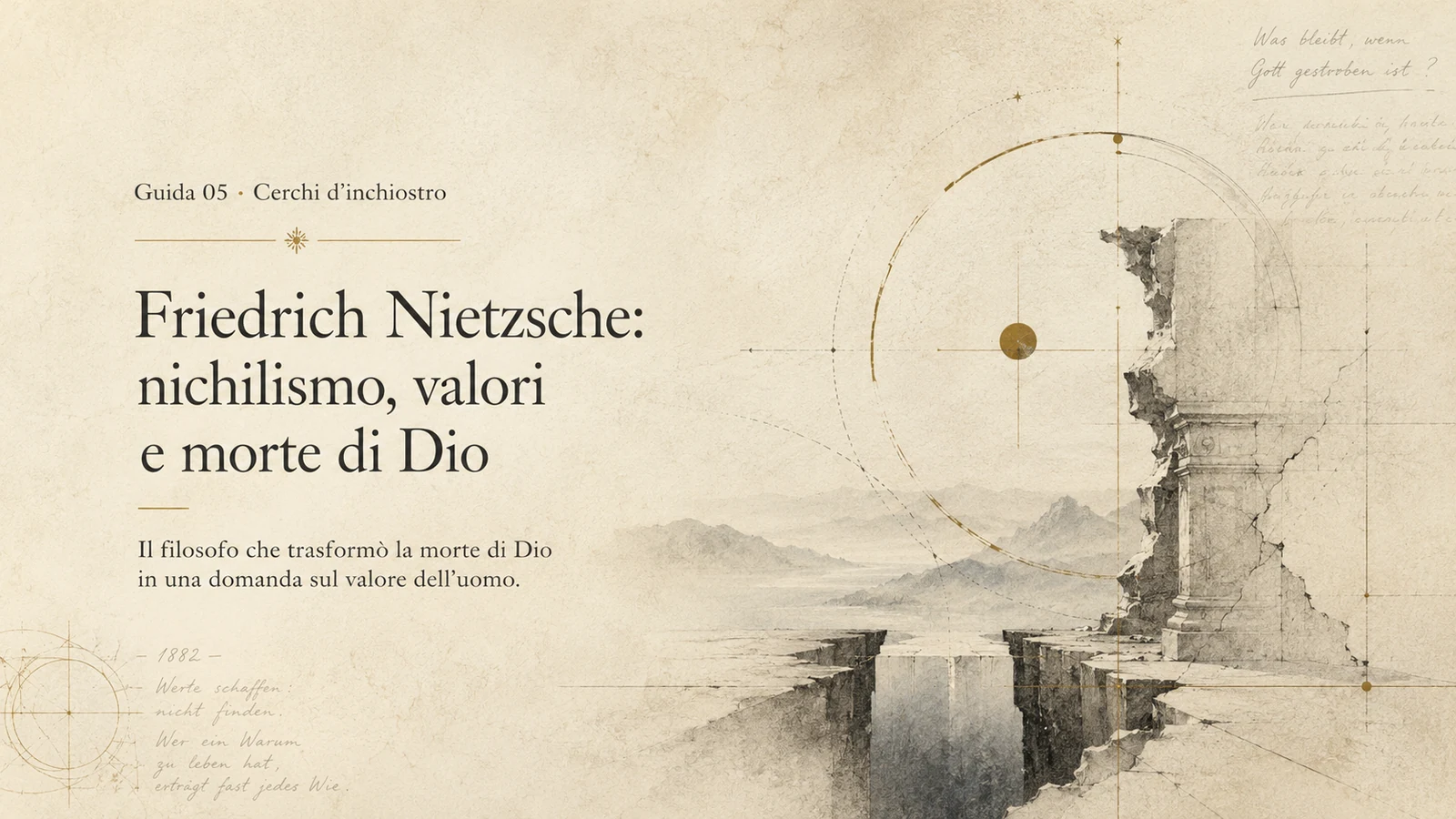
Friedrich Nietzsche was born in 1844 in Röcken and died in 1900. Trained as a classical philologist, he moved from Greek tragedy and Schopenhauer through a break with Wagner toward a radically mobile critique of morality, metaphysics and inherited values.
The Italian guide does not treat him as a philosopher of destruction for its own sake. His deeper problem begins after destruction: what happens when people can no longer believe in old foundations yet still live under inherited or newly disguised imperatives?
Nietzsche’s threshold is therefore the crisis of values — and the difficulty of creating forms of life after guarantees have disappeared.
Nietzsche in five minutes
Nietzsche’s major works include The Birth of Tragedy, Human, All Too Human, Dawn, The Gay Science, Thus Spoke Zarathustra, Beyond Good and Evil, On the Genealogy of Morality, Twilight of the Idols, The Antichrist and Ecce Homo.
His work moves through tragedy, the death of God, nihilism, genealogy, body, health, decadence, eternal recurrence and the possibility of creating values without relying on transcendent foundations.
The death of God: the loss of a foundation
The death of God is not simply the claim that God does not exist. The source guide treats it as a historical and spiritual diagnosis: the West has consumed a symbolic foundation that once supported moral and metaphysical order.
What matters is the lag between losing belief and understanding the consequences. A society can stop believing in a transcendent foundation while continuing to live through values inherited from it — or replacing it with new absolutes such as progress, nation, market, technique, public opinion, performance or compulsory happiness.
Nihilism, the last man and the problem of creation
Nihilism names the condition in which highest values lose their value. It is not simply sadness or fashionable pessimism. The old sources of meaning no longer persuade, but new values have not yet been created.
The “last man” represents one possible outcome: comfort, safety and administration without higher aspiration. The overhuman should not be reduced to biological, political or psychological superiority; in the Italian guide it marks the difficult possibility of creating values without falling back on transcendence or resentment.
Genealogy: asking where values come from
Genealogy refuses to take moral values at face value. It asks which forces, needs, histories and human types produced them. Morality becomes something with a history rather than a code that simply descended from nowhere.
This is also where Nietzsche’s analysis of resentment matters. The source guide distinguishes justice from reactive moral compensation: values can express creative strength, but they can also arise from impotence turned into judgment.
Eternal recurrence and will to power
The source guide treats eternal recurrence on several levels and refuses to collapse it into one closed doctrine. It can be read cosmologically, ethically and existentially: can one affirm this life rather than needing another world to justify it?
Will to power is likewise not reducible to domination over others. It names a more general dynamic of interpretation, organization and form-giving. Because these concepts are complex and especially vulnerable to posthumous simplification, the guide keeps them open rather than presenting a single formula as definitive.
A difficult legacy, not an innocent one
Nietzsche’s twentieth-century reception is controversial. The Italian guide separates his work from fascist and Nazi appropriations, while also refusing to make him harmless. His attacks on egalitarianism, mass democracy, compassion and Christianity remain severe and aristocratic.
The responsible task is double: distinguish the philosopher from later ideological manipulation, and still confront the abrasiveness of what he actually wrote.
Performance culture and obedience without belief
Nietzsche did not predict social media, personal branding or burnout. The source guide uses him more carefully: modern people can continue to obey even when they believe they have left authority behind.
Efficiency, growth, visibility, authenticity, success, resilience, productivity and permanent self-optimization may not present themselves as a morality. They often arrive as opportunities. That can make them harder to question.
The contemporary wound: obeying without believing
The Italian guide’s contemporary wound is a society saturated with undeclared values. The old command said “you must obey.” The new command often says “you can become anything.” But when failure is then interpreted entirely as personal inadequacy, possibility itself becomes disciplinary.
Nietzsche does not solve this by telling us to abandon values. A human being without values is not automatically free; the void can simply be filled by unexamined new idols.
The sharper question is: which values are we serving without having the courage to name them?
Primary texts and orientation
Primary orientation: Friedrich Nietzsche, The Birth of Tragedy, Human, All Too Human, Dawn, The Gay Science, Thus Spoke Zarathustra, Beyond Good and Evil, On the Genealogy of Morality, Twilight of the Idols, The Antichrist and Ecce Homo, the latter used with care as an autobiographical and interpretive text.
The Italian guide prioritizes the philological work of Giorgio Colli and Mazzino Montinari and points to Walter Kaufmann, Karl Jaspers, Martin Heidegger, Gilles Deleuze, Gianni Vattimo, Rüdiger Safranski, Brian Leiter and Bernard Reginster for major strands of critical reception.
Continue reading
The triad: capital, values, desire.
Read this guide as one node in the Marx–Nietzsche–Leopardi triad: three ways of asking how modernity organizes what we produce, what we believe and what we desire.