Introduction
Aristotle (384–322 BCE) enters Circles of Ink as the thinker of form. The Italian guide does not present his system as an ancient catalogue to memorize, but as a grammar for asking what makes something become what it can be.
His human problem is the distance between possibility and completion. Talent does not equal virtue; institutions do not equal a common good; technical capacity does not supply its own purpose.
For Aristotle, a life does not flourish by remaining indefinitely open. It takes form through habit, education, judgment, relationships and ends worth pursuing.
Form and matter: reality as organized possibility
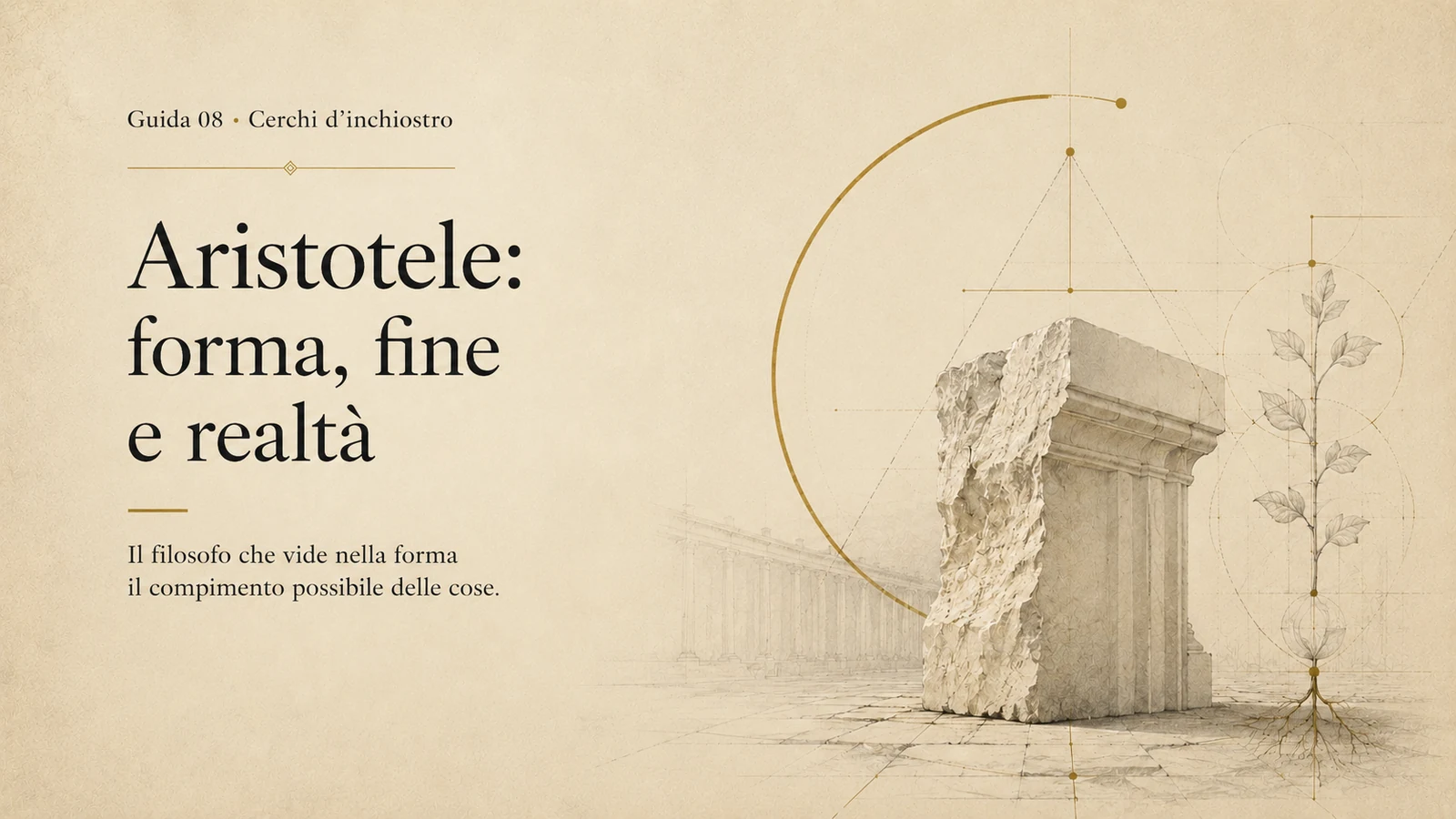
A concrete substance is not mere material. Matter is what something is made from; form is the principle that organizes it as the kind of thing it is. Form is therefore more than external shape: it gives structure, identity and intelligibility.
The source guide uses this distinction beyond metaphysics only as an analogy, not as proof: resources without organization do not yet make a project, and possibilities without form do not yet make a life.
Potentiality and actuality: a grammar of becoming
Potentiality names a real capacity to become or do something; actuality names its fulfillment in operation or achieved form. The distinction makes change intelligible without treating every possibility as equivalent.
Modernity loves options, access and capacity. Aristotle asks the harder question: which actuality justifies this potentiality? Not everything possible is thereby good, human or desirable.
The four causes: explanation needs more than mechanism
Aristotle distinguishes material, formal, efficient and final causes. To understand something fully is to ask what it is made of, what structure makes it what it is, what brought it about and what it is for.
The fourth question — the end — is especially disruptive today. A system can operate efficiently while remaining unclear about the kind of life its operation is meant to serve.
Virtue, habit and eudaimonia
In the Nicomachean Ethics, eudaimonia is not a passing pleasant feeling. It is a flourishing or successful life, an activity of the soul in accordance with virtue.
Virtue is a stable disposition formed through repeated action. This makes Aristotle’s ethics a theory of formation: knowing the good is insufficient unless a person becomes capable of doing it. Families, schools, institutions and communities therefore form habits even when they imagine they are merely transmitting rules or information.
Politics: the common life needs a form
Calling the human being a political animal means more than saying people live in groups. Through logos, humans share judgments about useful and harmful, just and unjust, good and bad.
The polis exists not only for survival but for living well. The source guide is careful not to map Aristotle’s ancient constitutional terms directly onto modern democracy. Its more durable question is which institutional forms orient a community toward a common good rather than the partial interest of rulers.
Technical power does not settle the question of ends
Every technology enlarges a capacity. An Aristotelian analysis asks what form and end should govern that capacity. The Italian guide applies this explicitly to artificial intelligence without either worshipping technical power or treating it as an absolute threat.
AI can produce texts, images, analyses and assisted decisions. None of those capacities by themselves answer what knowledge, judgment, education or labor should become.
The contemporary wound: the loss of form
The source guide’s contemporary wound is a present full of power but uncertain about completion: platforms without community, information without knowledge, competencies without character.
The loss of form appears in the individual, education, politics and technology whenever possibilities multiply faster than the structures capable of orienting them.
Aristotle’s question is not how much a life, city or system can do, but what it must become in order to be complete.
Primary texts and orientation
Primary orientation: Aristotle, Metaphysics, Physics, Categories, De interpretatione, Prior Analytics, Posterior Analytics, Topics, On the Soul, Nicomachean Ethics, Politics, Rhetoric, Poetics and major biological works.
The Italian guide points readers toward Werner Jaeger, Jonathan Barnes, W. D. Ross, Pierre Aubenque, Enrico Berti, Giovanni Reale, Terence Irwin and Martha Nussbaum, among other critical orientations.
Continue reading
The triad: time, form, disenchantment.
Read this guide as one node in the Seneca–Aristotle–Weber triad: three ways of asking which forms can keep a life, a community and a decision from dissolving into acceleration, apparatus and loss of purpose.