Introduction
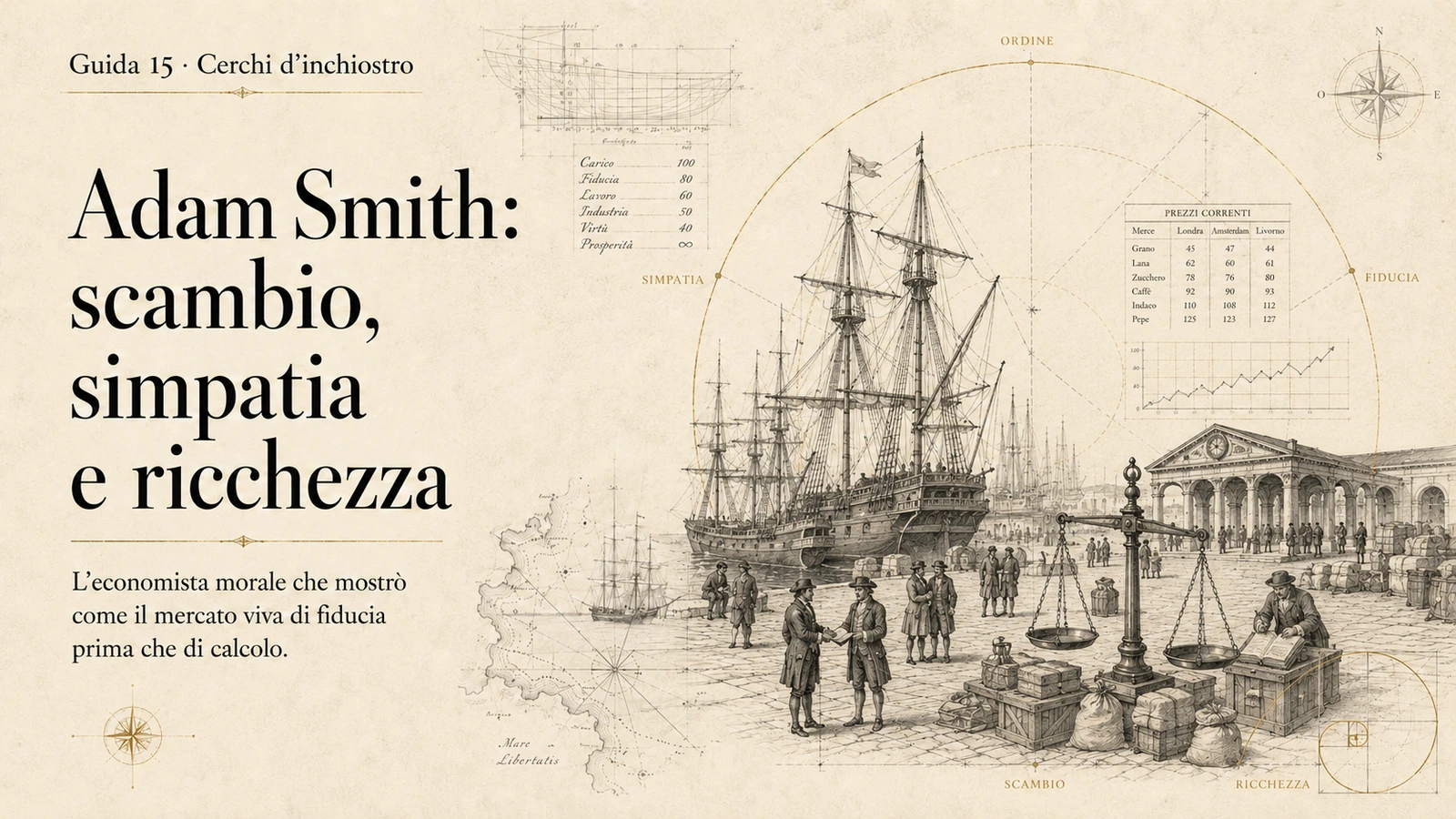
Adam Smith (1723–1790) enters Circles of Ink not as the author of a single market slogan but as a thinker of commercial society in its moral, economic and institutional dimensions.
The Italian guide asks a more demanding question than whether self-interest exists: how can a society of partial, advantage-seeking people generate credible relationships?
Smith’s answer connects sympathy, judgment, exchange, justice, division of labor, public institutions and trust. Economic cooperation does not float above civil life; it depends on it.
Sympathy and the impartial spectator
Sympathy is not generic kindness. In the source guide it is an imaginative capacity to place oneself in another person’s situation and evaluate whether passions appear proportionate to their circumstances.
This movement can turn inward. The impartial spectator is the attempt to judge oneself from a less partial standpoint. Smith’s person seeks advantage, but also lives under the gaze of others and wants both esteem and worthiness of esteem.
Exchange, interest and cooperation among strangers
Commercial society allows people without intimate bonds to become useful to one another by appealing to mutual interest. This does not mean that selfishness is sufficient for social order.
Exchange works only within a wider world in which money is accepted, fraud can be sanctioned, contracts have force and promises are sufficiently credible. Impersonal cooperation therefore depends on public forms of reliability.
Division of labor and the ambivalence of productivity
Division of labor increases productivity by specializing tasks, reducing transitions and making skills and tools more efficient. Smith sees this as one source of modern abundance.
He also sees the cost. A worker confined to a narrow repetitive function may lose intellectual breadth. The source guide treats public education as a civil correction to this danger, not as an ornament outside the economic system.
Wealth, markets and civil order
Smith’s wealth is not simply accumulated money. Commercial prosperity depends on productive capacity, work, security, administration, infrastructure, justice and institutions.
The Italian guide stresses his hostility to monopolies, protected interests and rules designed to shield narrow groups. A market order can widen common life only when law is not captured by the strongest economic actors.
The invisible hand: clarify it without turning it into a doctrine
The “invisible hand” appears rarely in Smith and should not be treated as the universal key to his thought. The source guide presents it as a metaphor for unintended effects that can arise under particular conditions.
Private interest does not automatically become public good. Law, competition, limits on privilege, credible exchange and justice matter. Without those conditions, organized interests can turn advantage into power very efficiently.
Smith is not a theory of isolated egoism
The guide rejects several shortcuts: Smith is not reducible to the invisible hand, does not abolish the state, does not treat every existing concentration of economic power as a market outcome to celebrate, and should not have The Theory of Moral Sentiments separated from The Wealth of Nations.
His commercial society is inhabited by moral judgment, public institutions and human beings whose lives are affected by specialization and recognition.
The contemporary wound: faceless trust
The source guide’s contemporary wound is the privatization and quantification of trust. Ratings, badges, rankings, histories, payment systems and automated verification make fast cooperation among strangers possible.
They also give those who control the infrastructure of credibility significant power over visibility and reputation. The problem is not technology as such, but what happens when trust becomes a proprietary service governed by opaque criteria.
Smith’s question returns in a new form: who guarantees trust when trust itself becomes part of the market?
Primary texts and orientation
Primary orientation: Adam Smith, The Theory of Moral Sentiments, An Inquiry into the Nature and Causes of the Wealth of Nations, Lectures on Jurisprudence and Lectures on Rhetoric and Belles Lettres.
The Italian guide points readers toward D. D. Raphael, A. L. Macfie, Knud Haakonssen, Nicholas Phillipson, Emma Rothschild, Samuel Fleischacker, Ryan Patrick Hanley, Amartya Sen, Donald Winch and Istvan Hont, and explicitly warns against reducing Smith either to market celebration or to a caricature of selfishness.
Continue reading
The triad: interpretation, money, exchange.
Read this guide as one node in the Averroes–Simmel–Smith triad: three ways of asking what lets strangers share a world when meaning must be interpreted, value made comparable and exchange sustained by trust.